Warehouses, offices, retail, farms, and schools all use electricity differently — which means they each need a different solar strategy. Here’s how to get yours right.
Commercial solar delivers strong returns across almost every UK business type, but the payback speed depends on one thing above all else: how much of your electricity you use during daylight hours. Warehouses and farms with large roofs and high daytime loads typically pay back in 3–4 years. Offices and retail sit at 3.5–5.5 years. Schools at 5–7 years. The right system for your business is designed around your actual consumption pattern — not a generic template.
Businesses use electricity in very different ways. A warehouse running refrigeration and forklift charging throughout the day is a completely different proposition to a school with term-time occupancy, or a retail unit with steady trading hours and consistent lighting loads. The way your business consumes electricity directly affects the size, design, and financial performance of your solar system.
Choosing the wrong setup can reduce energy savings, extend payback periods, and limit the return on your investment. This guide breaks down how commercial solar performs across the UK’s main business types, what drives ROI in each case, and what to consider before you commission a system.
This guide focuses on how solar performs across different business types. For costs, planning rules, mounting options, and the full installation process, our complete guide to commercial solar installation covers all of that in detail.
Two figures determine how well a commercial solar system performs financially: how much electricity you use during daylight hours, and how closely that usage matches your generation curve. This is called your self-consumption rate, and it is the single biggest driver of payback speed.
A business that uses most of its electricity between 9am and 5pm — when solar generation peaks — will see faster returns than one whose demand is concentrated in the evening or overnight. Roof type, available space, and seasonal demand patterns matter too, but consumption timing is what separates a three-year payback from a seven-year one.
A proper site survey and consumption analysis — reviewing your half-hourly smart meter data — should always come before any system is designed. Without it, you may be quoted for a system sized to your peak, not your daytime average, and the payback figure you’re given won’t stack up.
Warehouses and industrial premises are consistently among the strongest performers for commercial solar. Large, unobstructed roofs and high daytime energy loads create near-ideal conditions.
- Large flat roofs provide substantial space for high-capacity systems, often 50–150 kWp or more
- Daytime operations — lighting, conveyor systems, forklift charging, and HVAC — create high self-consumption throughout generation hours
- Ballasted mounting on flat roofs avoids penetrating the roof membrane, keeping installation costs efficient
- Cold storage and refrigeration loads provide a steady baseline demand that solar can offset throughout the day
- EV fleet charging during the day draws directly on self-generated power, further improving the financial case
Payback periods of three to four years are typical, with the system generating strong returns for a further 20–25 years beyond that.
If you’re planning fleet electrification, size the solar system now to account for future charging demand. Adding capacity later is possible but more expensive than getting the design right first time.
Office buildings have a consumption pattern that aligns closely with solar generation, making them a reliably strong fit — particularly through spring and summer when air conditioning and computing loads are at their highest during business hours.
- Air conditioning, lighting, and computing loads peak during business hours, exactly when solar output is highest
- Pitched or mixed-pitch roofs are common and may require in-roof or on-roof mounting rather than the ballasted approach used on flat roofs
- Multi-let buildings may need additional consideration for how electricity is metered and billed across occupiers
- Battery storage can capture daytime surplus for early morning start-up loads or extended working hours
Payback typically falls between three and a half and five years for buildings with strong daytime occupancy, extending to five to seven years where demand is more variable — such as part-occupied buildings or those with flexible working patterns.
Retail premises benefit from consistent, predictable energy demand throughout opening hours. From single units to larger stores, the combination of refrigeration, lighting, and POS systems creates a steady baseline that solar offsets reliably.
- Refrigeration, lighting, and POS systems create a steady baseline load well-suited to solar offset
- Consistent trading hours, typically aligned with daylight, support strong self-consumption rates
- Flat roofs on many standalone units and retail parks are well-suited to efficient ballasted mounting
- Sustainability credentials are increasingly important to customers and investors — visible solar supports brand positioning
Retail units with refrigeration typically see payback within four to five and a half years. Multi-site retailers should note that each location may have a different roof type, orientation, and consumption profile — a site-by-site survey is essential rather than assuming one design suits every store.
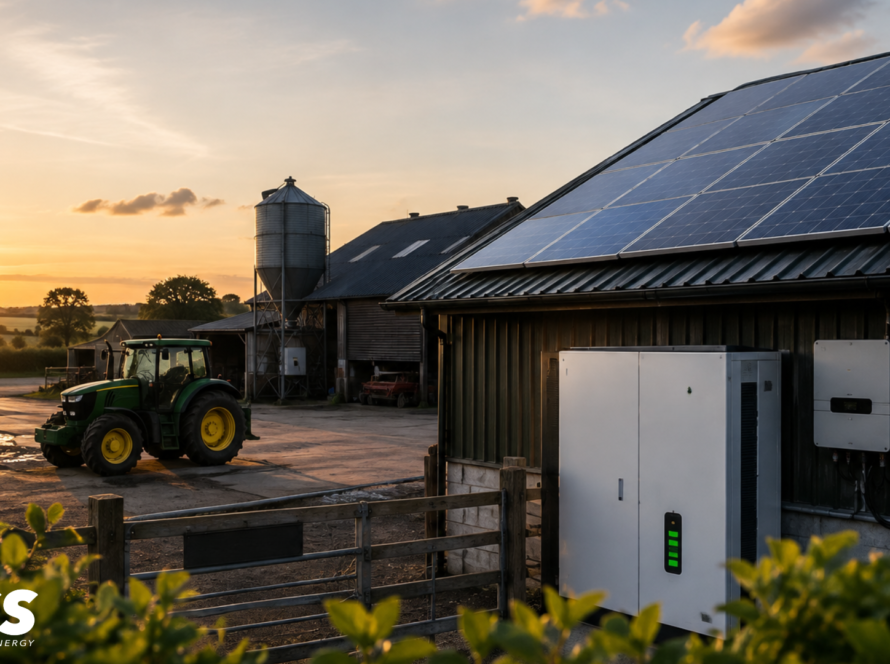
Farms and agricultural operations are one of the strongest commercial solar markets in the UK, particularly across Essex and the wider South East. Large roof areas and high seasonal electricity demand combine to create excellent conditions for rapid payback.
- Barn, outbuilding, and shed roofs provide extensive space for high-capacity systems, frequently 100 kWp or more
- Grain drying, refrigeration, irrigation pumps, and machinery charging create significant seasonal electricity demand that solar can match
- Ground-mounted systems may be an option where roof space is limited, subject to planning considerations
- Annual Investment Allowance and business rates exemption apply to agricultural solar the same as any other commercial installation
- Diversification income from solar can provide useful financial stability alongside variable agricultural revenue
Payback for agricultural solar typically falls between three and five years, helped by Essex’s above-average solar irradiance and the high seasonal loads common to farming operations.
The South East consistently records above-average solar irradiance for the UK. Agricultural systems in Essex regularly out-perform equivalent installations further north, shortening payback and increasing lifetime generation totals.
Educational and public sector buildings combine large roof areas with predictable energy use and strong institutional pressure to cut costs and emissions. Payback periods are longer than for warehouses or farms, but the case remains compelling given the scale of roofs and the budget benefits of reduced energy costs.
- Term-time occupancy creates a consistent daytime demand pattern broadly aligned with solar generation
- Large flat roofs on classroom blocks, halls, and sports facilities offer substantial installation capacity
- Reduced energy costs free up budget that can be redirected to front-line services or educational resources
- Net zero commitments that many schools and local authorities are now required to report against are supported by solar installations
Schools in Essex typically see payback within five to seven years. Public sector procurement processes can take longer than private commercial projects, so building in additional time for approvals and governance sign-off is worth planning for from the outset.
The table below shows typical payback ranges and key drivers across the main UK business types. These figures assume correctly sized systems based on actual site consumption data — generic sizing will typically produce longer payback periods.
| Business type | Typical system size | Typical payback | Key driver of ROI |
|---|---|---|---|
| Warehouse / Industrial | 50–150+ kWp | 3–4 years | Large flat roof; high daytime load from HVAC, conveyors, forklift charging |
| Agricultural / Farm | 100+ kWp | 3–5 years | Barn/shed roof space; seasonal peaks from grain drying, irrigation, refrigeration |
| Office / Commercial | 20–100 kWp | 3.5–5 years (full occupancy) | Business-hours consumption aligned with generation; battery extends gains |
| Retail | 20–80 kWp | 4–5.5 years | Consistent refrigeration and lighting load during trading hours |
| School / Public sector | 30–100 kWp | 5–7 years | Large roof capacity; term-time demand pattern; budget and net zero drivers |
- Self-consumption rate is the single biggest driver of how fast a system pays back — businesses with high daytime loads benefit most.
- Warehouses and farms offer the fastest returns thanks to large roof areas and consistent daytime electricity demand.
- Battery storage benefits businesses most where demand spills outside core solar hours — offices with early starts, retail open into the evening, or any site wanting resilience against outages.
- Multi-site businesses should survey each location individually — roof type, orientation, and consumption can vary significantly even within the same organisation.
- Every system should be designed from your actual half-hourly consumption data, not a generic template.
While the broad patterns above hold across most UK businesses, every site is different. The right system size, mounting method, and whether to include battery storage all depend on your specific roof, consumption profile, and growth plans.
- What proportion of our electricity use happens during daylight hours, and how does that vary by season?
- Is our roof flat or pitched, and what is its current condition and remaining lifespan?
- Do we have any planned changes to operations — such as fleet electrification or expansion — that should influence system sizing?
- Would battery storage meaningfully improve our self-consumption rate, given our specific demand pattern?
Find out how solar would perform for your business
We’ll assess your site, review your consumption data, and give you a straight, no-obligation quote — with a clear payback figure specific to your roof and usage. No jargon, no pressure.