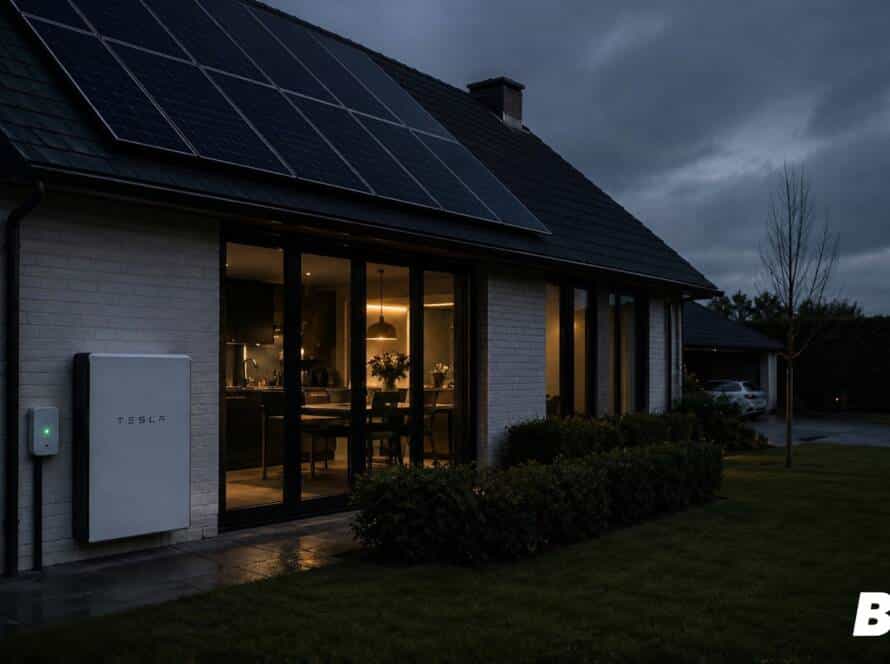
Your solar panels generate when the sun’s up. Your business uses electricity around the clock. A commercial battery storage system bridges that gap — but it isn’t always the right call. Here’s how to decide.
Commercial solar battery storage is worth adding when your business uses a meaningful share of electricity outside peak solar generation hours — typically before 9am, after 4pm, or at weekends. For businesses with strong daytime loads (warehouses, factories), panels alone often deliver fast payback without one. For offices with early starts, retail open into the evening, or any site needing resilience against outages, a battery meaningfully improves the financial case and typically adds £1,000–£3,000 per year in additional savings on a 50–100 kWp commercial system.
The case for commercial solar energy systems is well established: lower electricity bills, a shorter payback than ever, and a meaningful cut to your carbon footprint. The question of whether to add battery storage is less straightforward — and is one of the questions we get asked most during commercial site surveys.
The honest answer is: it depends on your business. For some operations, commercial solar storage accelerates the financial case significantly. For others, it adds cost without proportionate benefit. This guide gives you the framework to work out which applies to you.
This article is a cluster guide from our Commercial Solar for Different UK Business Types series. If you want the full picture on system design, planning, and installation costs first, start there.
A commercial solar battery storage system connects to your solar panels and to your site’s main electrical distribution. During the day, your panels generate electricity. Your business uses what it needs in real time. Any surplus — generation that would otherwise be exported to the grid for a small payment — is directed into the battery instead.
When generation drops (late afternoon, evenings, early mornings, or cloudy periods), the battery discharges and powers your site from stored energy. You’re drawing on electricity your panels generated, rather than buying from the grid at full rate. The effect is a higher self-consumption rate: the proportion of your own generation you actually use, rather than export.
Some commercial batteries can also charge from the grid at off-peak rates overnight, then discharge during peak-rate periods. On a time-of-use tariff, this grid arbitrage adds a second layer of savings on top of solar self-consumption — particularly relevant for businesses with high evening or morning demand.
There is no single right answer — but there is a clear framework. Commercial solar batteries deliver strong additional returns when the gap between your generation peak and your consumption peak is large. Where daytime loads already absorb most of what you generate, a battery has less to do.
If your site is busy before 9am, stays open into the evening, runs weekend shifts, or has any process that draws electricity when panels aren’t generating at full output, a battery closes that gap. Rather than buying grid electricity for those periods, you draw from what your panels stored earlier.
- Staff arrive before 8am and panels aren’t yet generating at output
- Your premises operate beyond 5pm, especially in autumn and winter
- Weekend trading or shifts create demand with no offsetting generation
- You want backup power resilience during grid outages
- You’re on, or moving to, a time-of-use commercial energy tariff
If your site runs heavy equipment, refrigeration, conveyors, or HVAC across a full working day, your solar panels are likely already feeding directly into live demand for most of their generation hours. Self-consumption rates of 60–75% are achievable without a battery at all. Adding one still improves the picture, but the incremental gain is smaller and the payback extension more significant.
Many warehouse and industrial operators start with panels alone, achieve payback in three to four years, and then add storage as a second phase — by which point battery costs have typically fallen and their consumption data from the first year informs a more accurate storage sizing decision.
- Daytime electricity demand is consistently high across all working hours
- Operations run Monday to Friday with no significant weekend load
- You want the fastest possible initial payback before adding further investment
- Half-hourly smart meter data shows minimal export during the working day
A commercial battery storage system with backup capability can maintain power to critical circuits during a grid outage — servers, refrigeration, security, lighting, and communications. For cold chain operators, food businesses, data-sensitive sites, or any operation where downtime has direct financial or reputational cost, the resilience value of battery storage can justify the investment independently of the savings case.
Not all battery systems support backup operation — it requires an inverter with island mode capability and correct system design from the outset. If resilience is a driver, make sure your installer designs for it from the start, not as an afterthought.
- Cold storage and food businesses with temperature-critical stock
- Data centres or IT-dependent operations with uptime obligations
- Healthcare or care sector sites with duty-of-care requirements
- Retailers or hospitality venues where a power cut closes the business
Some installers present battery storage as a way to “earn more” from solar. The SEG export payment is real but small — typically 4–15p per kWh. The real financial driver of battery storage is avoided import cost: every kWh you discharge from a battery instead of buying from the grid saves you 20–35p or more at current commercial rates. That is where the savings are, not in export income.
The table below summarises how strongly battery storage improves the financial case across the main UK commercial sectors. These assessments are based on typical consumption patterns — your specific site data may point to a different conclusion, which is why a half-hourly smart meter review is always the right starting point.
| Business type | Battery benefit | Key reason | Typical added saving |
|---|---|---|---|
| Offices | Strong | Early starts and extended hours create demand outside peak generation | £1,500–£3,000/yr |
| Retail | Strong | Evening trading and consistent overnight refrigeration benefit from stored power | £1,200–£2,500/yr |
| Hospitality | Strong | Evening and weekend demand peaks align poorly with solar generation hours | £1,500–£3,500/yr |
| Schools | Moderate | Term-time hours are well aligned with solar; battery mainly aids early morning loads | £800–£1,800/yr |
| Warehouses | Moderate | High daytime self-consumption already; battery adds value for out-of-hours shifts | £600–£1,500/yr |
| Agriculture | Moderate | Seasonal nature of demand limits year-round battery return; case is site-specific | £700–£1,800/yr |
| Industrial / Manufacturing | Lower (panels-first) | Very high continuous daytime load means panels alone achieve high self-consumption | £400–£1,000/yr |
Actual savings depend on your system size, electricity tariff, consumption pattern, and how much you export without a battery. We model the battery case specifically for your site during every commercial survey — you’ll see the numbers for your roof, your usage, and your tariff before committing.
Commercial battery storage is priced primarily by usable capacity (measured in kilowatt-hours, kWh) and by the inverter and battery management system specification needed for your site. Costs have fallen significantly over the past three years and continue to decline.
| Battery size (usable) | Typical supply & install cost | Best suited to | Indicative added annual saving |
|---|---|---|---|
| 30–50 kWh | £18,000–£28,000 | Small offices, retail units, schools (20–50 kWp solar system) | £1,000–£2,000/yr |
| 50–100 kWh | £26,000–£48,000 | Mid-size offices, larger retail, warehouses (50–100 kWp system) | £1,800–£3,500/yr |
| 100–200 kWh | £45,000–£85,000 | Large commercial sites, industrial, agricultural (100 kWp+ system) | £3,000–£6,000/yr |
| 200 kWh+ | From £80,000 | Large warehouse, multi-unit, or grid services applications | Subject to site modelling |
When comparing quotes, check what the usable capacity figure is — not just the headline kWh rating. Some batteries state total capacity but only allow access to 80–90% of it to protect battery longevity. A commercial solar battery quoted at 100 kWh with 90% depth of discharge gives you 90 kWh usable; one quoted at 100 kWh with 80% depth of discharge gives you 80 kWh. Always compare on usable kWh.
The tax treatment of commercial battery storage for solar is one of the most overlooked parts of the financial case. Two reliefs apply to most UK businesses and can significantly reduce the effective net cost of a battery system.
A 100 kWh commercial battery system at £55,000 gross cost: minus 0% VAT saving (already priced out), minus AIA relief at 25% corporation tax = £13,750 immediate tax saving. Net effective cost: £41,250. At £3,000/year in additional savings over panels alone, payback on the battery element alone is around 14 years — but alongside the faster-paying panels, total system payback on the combined investment typically still lands at 4–6 years.
The AIA limit, corporation tax rate, and VAT treatment of energy storage products are all subject to change. The figures above reflect the position as of June 2026. Before committing to a system, confirm the current rules with your accountant — we can provide the technical specifications needed for that conversation.
The single most common mistake in commercial solar energy systems with storage is a battery sized to the solar array rather than to the consumption pattern. A bigger battery is not always better — an oversized battery that never fully charges or discharges is capital sitting idle. The correct size is determined by the gap between what you generate and what you use, at each hour of the day, across every season.
Your smart meter records consumption in half-hourly intervals. That data shows exactly when your site draws power, how much, and how that varies across days, weeks, and seasons. Layering your solar generation profile on top reveals precisely how much surplus you’re generating at each interval — and therefore how much storage capacity would capture it usefully.
Proper sizing from this data produces a battery recommendation that matches your specific operation. A rule-of-thumb approach (commonly “1 kWh of storage per kWp of solar”) ignores consumption patterns entirely and often produces a system that is either too small to capture meaningful surplus or too large to be financially justified.
A battery sized for June’s surplus will be undersized in October and effectively idle in December. The right sizing decision balances the summer case (where a larger battery could theoretically be filled and emptied each day) against the autumn and winter case (where the battery may only partially cycle). For most commercial systems, this points to a moderate battery relative to array size — capturing 60–80% of the available surplus across the year rather than 100% of the summer peak.
If you’re planning to add electric vehicles to your fleet, expand your premises, or bring new high-draw equipment online in the next three to five years, size the battery (and the solar array) with that demand in mind. Retrofitting additional battery capacity later is possible but more expensive than designing for it from the start. A good commercial solar installer will ask about your growth plans before recommending a system size.
Commercial battery storage is more technically complex than residential. The inverter, battery management system, grid connection, and control logic all need to be correctly specified for your site — and the system needs to be commissioned and tested properly before it’s handed over. Here’s what separates a good commercial installation from a poor one.
- MCS-certified for both solar and battery storage — required for VAT relief and grid connection
- NAPIT or equivalent electrical certification for the commercial installation works
- Named battery brand and inverter brand on the quote — not generic descriptions
- Manufacturer-backed warranty for both battery and inverter, clearly stated in writing
- Half-hourly smart meter data reviewed before any system is sized or quoted
- Payback modelled for the battery separately from the solar panels, not combined into a single figure
- Seasonal variation in generation accounted for in the sizing recommendation
- Future load changes discussed and factored into the design where relevant
- Grid connection notification handled by the installer with your DNO — not left to you
- System commissioning and performance testing completed before handover
- Clear explanation of monitoring: how to read your system’s output and self-consumption data
- Defined aftercare process: who to call if the system faults, and what the response time is
- The financial case for commercial solar battery storage rests on avoided import cost — converting cheap surplus generation into displacement of expensive grid electricity.
- Offices, retail, and hospitality benefit most because their demand extends outside peak generation hours. Industrial sites with heavy daytime loads often achieve strong returns from panels alone.
- The Annual Investment Allowance allows 100% of the capital cost to be deducted from taxable profits in year one — a meaningful reduction in the effective net cost at current corporation tax rates.
- Correct sizing comes from half-hourly consumption data, not rule-of-thumb ratios. Oversized batteries don’t pay back faster — they pay back slower.
- Resilience is a separate, legitimate justification — for cold chain, IT-dependent, or public-facing operations, backup power capability has a value independent of the savings case.
- If you’re planning fleet electrification or expansion, build that demand into the system design now — it’s cheaper than retrofitting later.
Find out if battery storage is right for your business
We’ll review your smart meter data, model the battery case against your actual consumption, and give you a clear payback figure — before you commit to anything. Free, no obligation, no jargon.