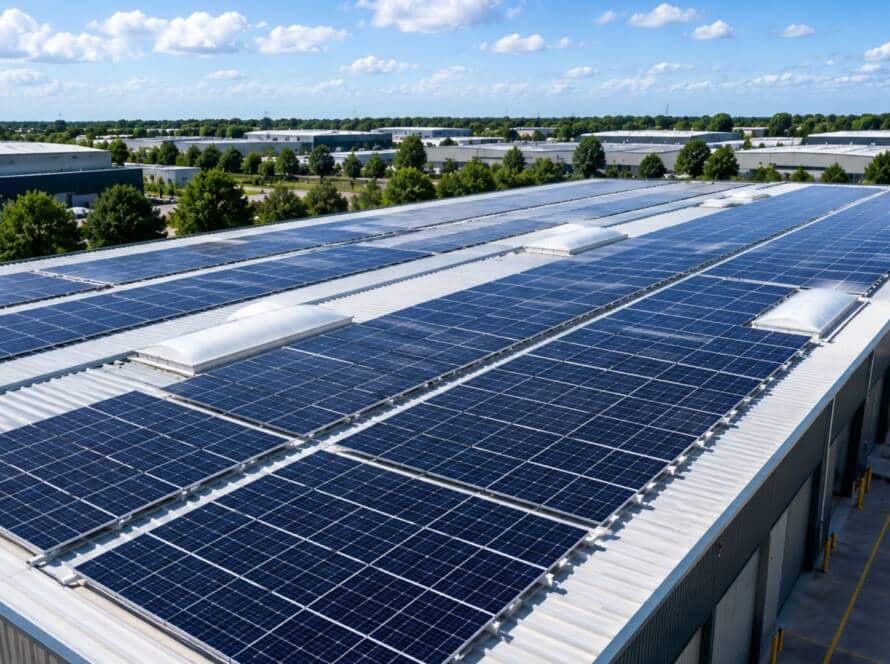
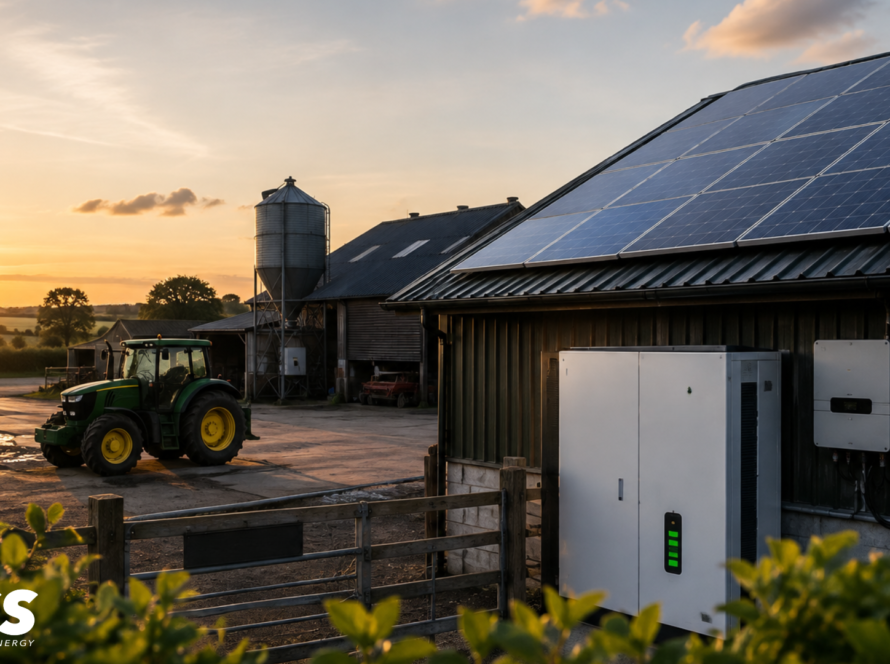
A plain-English guide to SEG eligibility, rates and applications for businesses with commercial solar — so you know exactly what your surplus energy is worth and how to claim it.
The Smart Export Guarantee (SEG) is a government-backed scheme that requires licensed electricity suppliers to pay businesses for surplus renewable electricity they export to the grid. To access it, your business needs an MCS-certified solar (or other eligible renewable) installation up to 5MW, a smart meter that records exports every half hour, and a signed-up tariff with a licensed SEG supplier. Commercial rates typically run from around 3–15p per kWh, but the bigger win for most businesses is self-consumption — using the power on site is worth three to four times more than exporting it, so SEG should be treated as a bonus income stream on top, not the main event.
If your business has installed, or is considering, commercial solar panels, you’ve probably come across the term “SEG” in a quote or a supplier’s paperwork. It sounds like small print, but it’s actually a straightforward mechanism for turning surplus electricity into income — provided you understand what it does and doesn’t cover.
This guide sets out exactly what the Smart Export Guarantee is, whether your business qualifies, what it’s realistically worth, and the practical steps to get signed up. We’ll also flag where SEG fits into the wider financial case for commercial solar, because on its own it’s rarely the headline figure.
SEG only pays for electricity you send back to the grid — not for everything your system generates. Every unit your business uses on site displaces electricity you’d otherwise buy at your full commercial import rate, which is usually three to four times higher than any SEG export rate. The real prize is sizing your system so you consume most of what you generate, with SEG mopping up the surplus.
The Smart Export Guarantee is a UK government scheme, introduced in January 2020, that requires Ofgem-licensed electricity suppliers with 150,000 or more customers to offer at least one export tariff to small-scale generators — including commercial solar users. Smaller suppliers can join voluntarily, which is why the market now includes a mix of household names and specialist business-energy suppliers.
SEG replaced the old Feed-in Tariff (FiT), which closed to new applicants in 2019. The key difference is that FiT paid a fixed, government-set rate for every unit generated, whether you used it or exported it. SEG only pays for what you export, and the rate is set by each supplier rather than by government — so it varies, and it can change with 30 days’ notice. The one guarantee built into the scheme is that the rate must be above zero; beyond that, it’s a competitive market and worth shopping around in.
You don’t need to take your SEG export tariff from the same supplier that provides your business’s electricity import. Many businesses keep their existing import contract and switch only their export payments to whichever supplier offers the best commercial SEG rate.
This guide focuses on how solar performs across different business types. For costs, planning rules, mounting options, and the full installation process, our complete guide to commercial solar installation covers all of that in detail.
SEG eligibility is defined by the installation itself rather than the type of property, so most commercial sites with solar, wind or other qualifying renewable generation can apply. Three requirements gate access, and all three need to be met before you can register.
Your installation must be certified by the Microgeneration Certification Scheme (MCS) or hold Flexi-Orb certification, and carried out by an MCS-certified contractor — an installation from a non-certified installer can’t be registered for SEG, regardless of how well it performs. The system also needs a generation capacity of no more than 5MW, which covers the overwhelming majority of commercial rooftop and ground-mount arrays.
- MCS certificate number from your installer
- Confirmation the system is under 5MW capacity
- Proof of ownership, or written permission from the owner if leased
Your site needs a smart meter, or half-hourly electricity meter, capable of recording exported electricity every 30 minutes and transmitting that data to your supplier. Most commercial sites already have half-hourly metering for billing purposes, so this is often already in place — but it’s worth confirming with your energy team before you assume you’re covered.
You can’t receive SEG payments from more than one supplier, and you can’t combine SEG export payments with Feed-in Tariff export payments on the same installation. If your business still receives FiT generation payments from a pre-2019 installation, you can continue receiving those — but you’d need to opt out of the FiT export element specifically to move to a SEG tariff instead.
Commercial SEG rates in 2026 typically sit lower than the equivalent residential tariffs, where the strongest offers reach up to around 15–16p/kWh. For business customers, standard fixed commercial tariffs generally run between 3p and 8p per kWh, with a handful of the most competitive supplier offers reaching up to around 15p/kWh. Time-of-use tariffs can pay considerably more during peak demand windows, but they require active management and metering that supports it.
| Tariff type | Typical rate | Payment style | Best for |
|---|---|---|---|
| Standard fixed | 3–8p/kWh | Fixed for 12–36 months, quarterly | Predictable, low-effort businesses |
| Premium fixed | Up to ~15p/kWh | Fixed, often requires import bundling | Businesses willing to switch import supplier |
| Time-of-use / variable | Tracks wholesale price | Half-hourly, can spike at peak times | Sites with battery storage and flexible export |
Every unit your business self-consumes displaces grid electricity at your full commercial import rate — commonly 24–28p/kWh — while every exported unit only earns the SEG rate. A system sized to maximise self-consumption, with SEG as a secondary income stream on genuine surplus, will almost always out-earn one designed to chase export income.
To put the comparison in concrete terms: a 100kWp commercial system generating 90,000 kWh a year, with 80% used on site and 20% exported at a 7p SEG rate, would save roughly £18,700 a year in avoided imports — with SEG contributing a further, smaller sum on top. For the full breakdown of how commercial solar pays back over time, see our commercial solar cost and ROI guide.
SEG payments aren’t automatic — your business has to actively sign up with a chosen supplier once the installation is complete. The process is administrative rather than technical, and most businesses can complete it within a couple of billing cycles.
Fixed tariffs lock in a known rate for the contract term — typically 12 to 36 months — and suit businesses that want predictable, low-maintenance income from a system without a battery, since export volumes are largely dictated by daylight rather than choice. Variable, or time-of-use, tariffs track the wholesale electricity price and can pay significantly more during peak demand windows, but they reward businesses that can actively shift export activity — for example, discharging a battery during an evening price spike rather than exporting flat throughout the day.
If your site doesn’t have battery storage, a fixed tariff is usually the more practical choice, since you can’t influence when your surplus is generated. If you’re weighing up whether storage makes sense for your business, our guide to commercial battery storage covers the sums in more detail.
Yes. Where a domestic household’s SEG income is generally treated as tax-free, SEG payments received by a commercial business are treated as trading income and are taxable, in the same way any other business revenue would be. It’s worth keeping annual payment statements from your SEG supplier alongside your other accounting records, and flagging the income to your accountant so it’s declared correctly.
SEG payments aren’t linked to other financial support for renewable installations, so a business can generally combine SEG income with other available incentives on the same system — always worth checking current eligibility, since schemes and thresholds change.
- MCS or Flexi-Orb certified, fitted by a certified contractor
- Generation capacity of 5MW or under
- Any battery storage is solar-charged only, not grid-charged
- Smart or half-hourly meter capable of recording exports
- MPAN and export details confirmed with your energy team
- MCS certificate number to hand
- Not currently receiving FiT export or another supplier’s SEG payments
- Accountant briefed that SEG income is taxable trading income
- SEG pays commercial businesses for surplus electricity exported to the grid — not for everything a system generates.
- Eligibility needs an MCS-certified system up to 5MW, a half-hourly export meter, and a signed-up SEG supplier.
- Commercial rates typically run 3–15p/kWh, well below the value of self-consumed electricity.
- You don’t need to switch your import supplier to access a competitive SEG export tariff.
- SEG income is taxable trading income for a business, unlike the tax-free treatment for most households.
Model your business’s SEG income
We’ll assess your site, size a system around your usage, and show you exactly what self-consumption and export could be worth — with named kit and a clear payback figure.