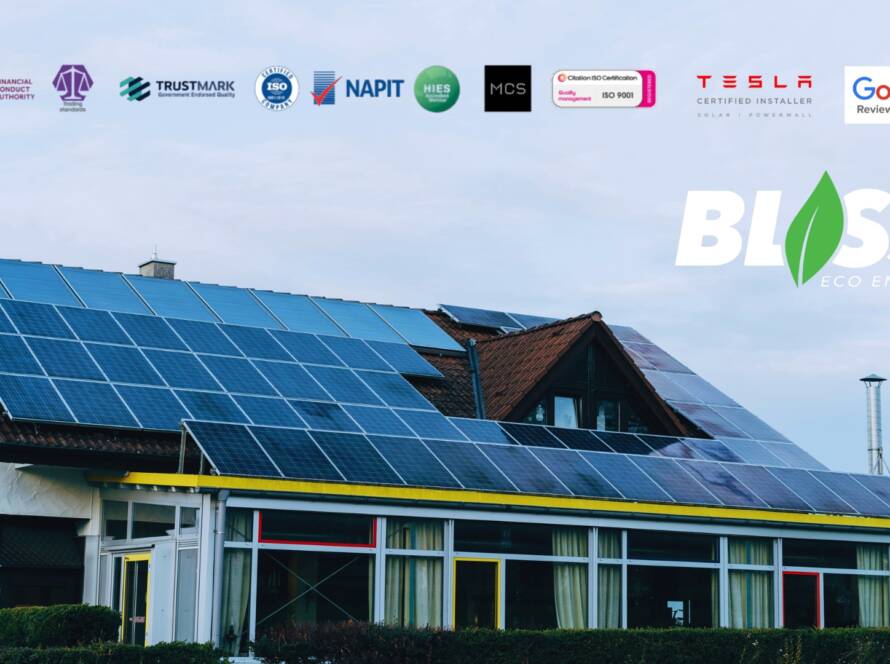
Last reviewed: June 2026 | Published by Bliss Eco Energy Ltd | MCS Certified Installer
About this guide
This guide was produced by Bliss Eco Energy, an MCS-certified commercial solar installer headquartered in Southend-on-Sea, Essex. Since 2017, our team has completed over 300 commercial solar installations across Essex, London, and South East England, totalling more than 8 MWp of installed capacity. All financial figures and timelines reflect real-world project data from our 2022–2025 installation portfolio unless otherwise stated.
Accreditations: MCS | NAPIT | TrustMark | HIES | Tesla Powerwall Certified Installer
Why 2026 Is the Year UK Businesses Must Act on Solar
Energy bills for UK businesses are not going back to where they were. Commercial electricity prices have stabilised at 28–32p per kWh, roughly double the pre-2021 baseline, and forecasts through to 2030 offer little relief. For a business spending £50,000 or more on electricity each year, that is a material operational cost that is entirely within your control to reduce.
Commercial solar installation is no longer a fringe sustainability decision. It is, for thousands of UK businesses right now, the single most effective lever for cutting overheads, meeting net zero commitments, and future-proofing against energy volatility. In 2026, payback periods of three to five years are realistic for well-sized commercial systems, and after payback, decades of near-free electricity follow.
This guide covers everything your business needs to make a fully informed decision: how commercial solar works, what it costs, what the regulations require, how the installation process unfolds, and how to choose the right installer. Whether you run a warehouse in Basildon, an office block in Chelmsford, or a retail unit in Colchester, the fundamentals are the same. Bliss Eco Energy is here to help you navigate every step.
What Is Commercial Solar Installation?
Commercial solar installation is the design, supply, and fitting of solar photovoltaic (PV) systems on business premises, typically sized from 30 kWp upwards. Unlike residential solar, commercial systems are built to handle higher energy demand, use industrial-grade components, and are typically sized from 10 kWp upwards, often into the hundreds of kilowatts.
How does it work?
Solar PV panels convert sunlight into direct current (DC) electricity. An inverter then converts this to alternating current (AC), which your business uses to power everything from lighting and machinery to HVAC systems and EV chargers. Any surplus electricity not used on-site can be exported to the grid via the Smart Export Guarantee (SEG), generating additional income.
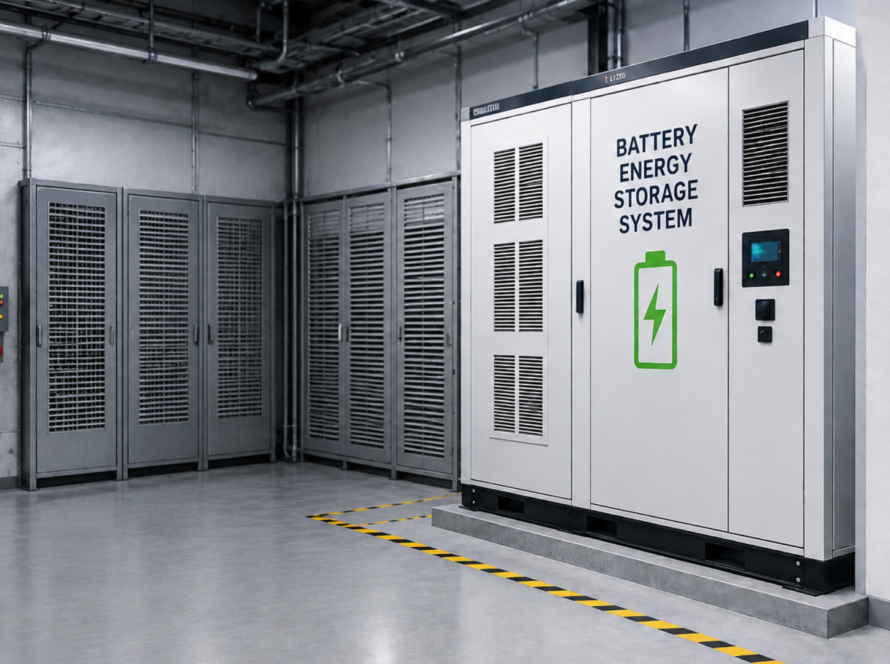
Modern commercial systems can also be paired with battery storage — allowing your business to bank surplus daytime generation for use during evenings or peak tariff periods — and with EV charging points for staff and fleet vehicles.
Here is how commercial solar compares to residential in the UK in 2026
| Feature | Commercial Solar | Residential Solar |
|---|---|---|
| Typical system size | 30 kWp–1 MWp+ | 3–13 kWp |
| Installation time | 2–8 weeks | 1–2 days |
| Grid connection | G99 application required | G98 notification |
| Planning permission | Often required above 50 kWp | Usually permitted development |
| Payback period | 3–7 years | 6–12 years |
| Components | Industrial-grade, 3-phase | Standard residential |
The Financial Case: Costs, Savings and ROI in 2026
How much does commercial solar installation cost?
Commercial solar PV in the UK currently costs between £660 and £1,200 per kWp installed in 2026, depending on system size, roof type, and installation complexity. Larger systems benefit significantly from economies of scale.
Note: costs are based on standard commercial installations in the UK in 2026 and exclude VAT. Site-specific factors such as roof condition, structural reinforcement, and DNO connection complexity may affect the final figure.
What is the ROI on commercial solar in 2026?
The typical payback period for a commercial solar installation in the UK in 2026 is 3–5 years, but the range varies meaningfully by business type. Based on Bliss Eco Energy’s portfolio of 2023–2025 commercial installations across Essex and the South East:
| Business Type | Typical Payback | Why |
|---|---|---|
| Flat-roof warehouse, 50–150 kWp, high daytime load | 3–4 years | High self-consumption; large unobstructed roof area |
| Office building with AC/computing load, 30–80 kWp | 3.5–5 years | Daytime-heavy consumption aligns with peak generation |
| Retail unit with refrigeration, 20–50 kWp | 4–5.5 years | Consistent baseline load; good self-consumption |
| Agricultural building, 100 kWp+ | 3–5 years | Large roof, high seasonal loads, strong irradiance in Essex |
| Pitched-roof office, variable daytime load | 5–7 years | Lower self-consumption rate without battery storage |
After payback, the system continues generating substantial savings for a further 20–25 years. Annual ROI post-payback typically runs at 15–25% on invested capital, with energy bill reductions of 40–80% depending on self-consumption profile and whether battery storage is included.
Tax incentives and financial support in 2026
- Annual Investment Allowance (AIA): Solar panels qualify for 100% AIA deduction from pre-tax profits in year one (up to £1m per accounting period). For a profitable business at 25% corporation tax, this reduces the net cost of a £200,000 system by £50,000. Source: HMRC Capital Allowances guidance.
- 50% First Year Allowance (FYA): For expenditure beyond the £1m AIA cap, 50% of the excess cost can be deducted in year one, with the remainder written down at the standard 6% rate.
- Business rates exemption: A landmark policy running from April 2023 to 2035 provides a 100% exemption from business rates for new rooftop solar installations. Your investment will not increase your property’s rateable value.
- Zero VAT on installation: Commercial solar panel installations are subject to 0% VAT in the UK.
- Smart Export Guarantee (SEG): Export surplus electricity to the grid for payment via Ofgem-regulated SEG tariffs. Rates vary by supplier and tariff type.
Is Your Commercial Property Suitable for Solar?
The vast majority of commercial buildings can accommodate a solar system with the right design. Here is what a good commercial solar installer will assess during your site survey.
Roof type and condition
- Flat roofs (common on warehouses, factories, and offices) are ideal for commercial solar. Panels are typically mounted on ballasted frames at an optimal angle without penetrating the roof membrane. Bliss Eco Energy specialises in flat roof solar installation across Essex and South East England, with over 200 flat-roof commercial systems completed.
- Pitched roofs can accommodate in-roof or on-roof systems, provided the pitch and orientation are suitable.
- Roof condition matters. If your roof is nearing the end of its life, it is advisable to carry out any necessary repairs or re-roofing before solar installation.
Orientation and shading
South-facing roofs generate the most power in the UK, but east-west orientations can also work well, particularly on flat roofs where panels can face both directions. Shading from neighbouring buildings, trees, or plant equipment should be assessed carefully. Modern microinverter and optimiser technology can mitigate the impact of partial shading significantly.
Structural load
Commercial solar panels add weight to your roof. Particularly for older flat-roofed buildings, a structural survey is often required to confirm the roof can support the additional load. Your installer should arrange or recommend this as part of the project.
Energy consumption profile
The greater your daytime electricity consumption, the higher your self-consumption rate and the stronger your ROI. Our team analyses your energy bills and smart meter half-hourly data to size the system correctly and model your expected savings scenario by scenario.
Planning Permission and Regulations
Do you need planning permission for commercial solar?
Most roof-mounted commercial solar installations fall under permitted development rights and do not require planning permission — provided panels do not protrude more than 200mm from the roof surface.
However, the following situations are likely to require a full planning application:
- Buildings in conservation areas or designated as listed buildings
- Ground-mounted systems or solar canopies
- Very large installations that materially alter the appearance of a building
- Sites with specific local planning restrictions
If in doubt, our MCS-certified installer will advise at the site survey stage. Bliss Eco Energy has successfully managed planning applications for commercial solar installations across multiple Essex local planning authorities, including Southend-on-Sea City Council, Chelmsford City Council, and Basildon Borough Council.
Grid connection: G98 and G99 explained
Commercial solar systems above 3.68 kW per phase need G99 approval from the Distribution Network Operator (DNO) before the system can be commissioned. Most commercial solar installations require this approval.
- G98: Applies to smaller systems (under 3.68 kW per phase). A simple notification process; you inform the DNO after installation.
- G99: Required for commercial systems. Formal DNO approval is needed before commissioning. The DNO assesses whether the local network can accommodate the additional generation. Submit early to avoid programme delays. Ideally in parallel with any planning application.
Bliss Eco Energy manages the G99 application process on behalf of clients as a standard part of every commercial installation.
MCS certification and building regulations
All commercial solar installations should be carried out by an MCS (Microgeneration Certification Scheme) certified installer. MCS certification is a requirement for accessing the Smart Export Guarantee and provides consumer protection under the MCS Consumer Code.
Bliss Eco Energy holds MCS certification alongside NAPIT, HIES, and TrustMark accreditations, giving businesses across Essex and South East England complete confidence in the quality and compliance of their installation.
The Commercial Solar Installation Process: Step by Step
Understanding the process from initial enquiry to final switch-on helps you plan effectively and avoid common programme pitfalls. Here is how a professional commercial solar installation typically unfolds.
Stage 1: Initial Consultation and Site Survey
An experienced surveyor visits your site to assess roof structure, orientation, shading, and condition, and reviews your energy consumption data. This stage produces a detailed proposal covering system design, expected generation, savings modelling, and a fixed-price quotation. Bliss Eco Energy delivers site survey proposals within five working days of initial enquiry.
Stage 2: System Design and Specification
Based on the site survey, a full system design is produced — specifying panel makes and models, inverter type and configuration, mounting system, battery storage (if applicable), and cable routing and electrical layout. A well-designed system balances maximum energy output with the specific constraints and characteristics of your building.
Stage 3: Planning and Grid Connection Applications
Where planning permission is required, Bliss Eco Energy advises on and manages the application process. The G99 grid connection application is submitted to your DNO simultaneously, running both workstreams in parallel to minimise delay.
Stage 4: Procurement and Scheduling
Once approvals are in place, panels, inverters, mounting hardware, and all electrical components are procured. Installation is scheduled with minimal disruption to your business operations — most commercial installations can be completed within two to eight weeks depending on system size.
Stage 5: Installation
Bliss Eco Energy’s installation teams carry out the physical installation. This includes mounting the racking system, fitting the panels, running DC cabling, installing the inverter and consumer unit connections, and integrating any battery storage or EV charging systems.
Stage 6: Commissioning, DNO Energisation and Handover
Once installed, the system is commissioned and tested. Following DNO approval to energise, the system is switched on, and your monitoring platform is configured. You receive a full handover including warranties, system documentation, monitoring access, and guidance on maximising your self-consumption and SEG export income.
Typical timeline from enquiry to switch-on: 6–14 weeks, depending on system size, planning requirements, and DNO timescales.
Bliss Eco Energy target: Quote to completion in as little as 14 days for straightforward installations.
Choosing the Right Commercial Solar Installer
The quality of your installer is as important as the quality of your panels. A poorly designed or installed system will underperform, create maintenance headaches, and potentially void manufacturer warranties. Here is what to look for.
Key accreditations to verify
- MCS (Microgeneration Certification Scheme): The industry standard. Non-negotiable for accessing the Smart Export Guarantee and consumer protection schemes.
- NAPIT or NICEIC registration: Confirms your installer is a qualified and registered electrical contractor.
- TrustMark certification: A government-endorsed quality mark for tradespeople working in and around the home and business.
- HIES (Home Insulation and Energy Systems Quality Assured Contractor Scheme): Provides additional consumer protection and an independent dispute resolution service.
Questions to ask before you commit
- How many commercial solar installations have you completed, and can you provide references or case studies?
- Do you carry out all work with your own employed teams, or do you subcontract?
- What panel and inverter brands do you use, and what warranties do they carry?
- Will you handle the G99 application and liaise with the DNO on our behalf?
- What monitoring system do you provide, and how do we access it?
- What after-sales support and maintenance packages do you offer?
Why businesses across Essex choose Bliss Eco Energy
Bliss Eco Energy is a fully MCS, NAPIT, HIES, and TrustMark certified commercial solar installer headquartered in Southend-on-Sea, serving businesses across Essex, London, and South East England. Our commercial team brings hands-on expertise, premium technology, and a commitment to transparent communication at every stage.
We work with a range of trusted technology partners, including Tesla Powerwall (certified installer), Enphase, SolarEdge, SolaX, and Fox ESS. We carry out all installations with our professional engineers and electricians. Our track record of consistently five-star reviews across Southend, Basildon, Chelmsford, Colchester, and beyond reflects our commitment to quality installation and after-sales care.
Commercial Solar with Battery Storage
Adding commercial battery storage to your commercial solar installation unlocks a new level of energy independence and financial return. Rather than exporting surplus solar generation at low SEG rates, a battery allows you to store that energy and use it when your business needs it most — including evenings, overnight, or during peak-tariff periods.
Key benefits of commercial battery storage
- Peak demand shaving: Avoid expensive peak-rate grid electricity by drawing on your battery during high-tariff periods.
- Backup power: In the event of a grid outage, battery storage with appropriate configuration can maintain power to critical systems.
- Maximised self-consumption: Use more of what you generate, reducing your reliance on the grid and accelerating payback.
- Grid flexibility: Participate in demand-side response schemes through your energy supplier.
Bliss Eco Energy is a certified Tesla Powerwall installer, as well as working with leading battery brands including Fox ESS and SolaX Power. All our commercial installations are battery-ready, giving you the flexibility to add storage now or upgrade in the future.
Commercial Solar for Different Business Types
Solar panels for commercial business deliver different returns depending on your sector, roof type, and energy usage pattern. Whatever your industry, commercial solar panels for business are a proven way to cut overheads and strengthen your sustainability credentials.
Warehouses and industrial units
Large, flat-roofed warehouses are among the most cost-effective commercial solar opportunities in the UK. High roof space, significant daytime energy demand, and typically unobstructed aspects make for excellent generation profiles and high self-consumption rates.
Offices and commercial premises
Office buildings benefit strongly from solar given their daytime-heavy consumption patterns. Air conditioning, lighting, and computing loads align well with peak solar generation during summer months.
Retail businesses
Retail units with consistent opening hours and significant lighting and refrigeration loads are well-suited to commercial solar. Many retailers are also under increasing pressure from customers and investors to demonstrate sustainability credentials.
Agricultural businesses in Essex
Essex’s agricultural sector is one of the strongest commercial solar markets in the UK. Farms benefit from large available roof or land space, high electricity consumption for grain drying, refrigeration, and machinery, and strong alignment with sustainability goals. Agricultural solar also qualifies for the same AIA and business rates exemption as any other commercial installation.
Schools and public sector organisations
Educational and public sector buildings have large roof areas, predictable energy profiles, and strong incentives to reduce operating costs and carbon emissions. Solar installations on schools in Essex typically achieve payback within 5–7 years and can meaningfully contribute to a school’s or local authority’s net zero targets.
Commercial Solar Installation in Essex and South East England
Essex is one of the UK’s strongest regions for commercial solar. Businesses benefit from above-average solar irradiance, a large and diverse business base, and growing pressure to meet net zero targets ahead of the UK’s 2050 commitment.
Bliss Eco Energy is headquartered in Southend-on-Sea and delivers commercial solar installations across Essex and beyond. Local knowledge of DNO networks, planning authorities, and Essex-specific site conditions means faster applications, fewer delays, and a more straightforward installation experience for your business.
Areas we serve for commercial solar installation in Essex:
- Southend-on-Sea and Leigh-on-Sea
- Basildon and Castle Point
- Chelmsford and Brentwood
- Colchester and Tendring
- Rayleigh, Hockley, and Rochford
- London and the wider South East
To book a free, no-obligation commercial solar site survey for your Essex or South East England business, call us on 01702 933 388 or email info@bliss-ecoenergy.com.
Monitoring and Maintaining Your Commercial Solar System
Solar monitoring
All commercial systems installed by Bliss Eco Energy include access to a real-time monitoring platform, allowing you to track your system’s generation, self-consumption, export, and battery state at any time, from any device. Proactive monitoring alerts you to any underperformance quickly, so issues are resolved before they affect your savings.
Ongoing maintenance
Commercial solar systems require minimal maintenance, but periodic checks are advisable to maintain peak performance:
- Annual inspection: A qualified engineer checks all electrical connections, panel condition, inverter operation, and mounting integrity.
- Panel cleaning: Depending on your location and roof pitch, periodic cleaning can maintain output — particularly relevant for flat-roof installations where rain runoff is less effective.
- Inverter servicing: Inverters carry 5–12 year warranties. Replacement may be required during the system’s 25–30 year lifespan.
Ready to Get Started? Request Your Free Commercial Solar Survey
Bliss Eco Energy provides free, no-obligation commercial solar surveys and proposals for businesses across Essex, London, and South East England. Our commercial team will assess your site, model your expected savings, and provide a detailed fixed-price quotation — typically within five working days.
Phone: Southend: 01702 933 388 | Basildon: 01268 218120
Email: info@bliss-ecoenergy.com
Website: bliss-ecoenergy.com/services/commercial-solar-installation-essex/
Office: 76 London Road, Southend-on-Sea, SS1 1PG | Mon–Fri 9am–5pm
Join hundreds of satisfied businesses across Essex who have already made the switch to solar with Bliss Eco Energy. MCS certified. Locally trusted. Nationally recognised.
Conclusion
Commercial solar installation has become one of the most effective investments UK businesses can make in 2026. With energy costs remaining high, attractive tax incentives available, and payback periods often achieved within three to five years, commercial solar offers a practical way to reduce operating expenses while supporting long-term sustainability goals.
Whether you manage a warehouse, office, retail premises, agricultural facility, or industrial site, a professionally designed solar PV system can deliver decades of reliable energy generation and significant financial savings. When combined with battery storage, businesses can further increase energy independence, improve self-consumption rates, and protect themselves from future electricity price volatility.
Choosing an experienced and accredited installer is essential to maximising performance and return on investment. From initial site surveys and system design to grid connection, installation, and ongoing support, every stage should be handled with expertise and transparency.
Bliss Eco Energy has helped over 300 businesses across Essex, London, and the South East unlock the full financial and sustainability benefits of commercial solar. If you are ready to reduce energy costs, improve your sustainability credentials, and future-proof your business, now is the right time to act.
Book your free commercial solar survey today and discover how much your business could save with a bespoke solar solution from Bliss Eco Energy.
Frequently Asked Questions
1. How much does a commercial solar installation cost in the UK?
Commercial solar installations in the UK cost between £660 and £1,200 per kWp installed in 2026, depending on system size, roof type, and complexity.
2. How long does a commercial solar installation take?
Most commercial solar installations take between two and eight weeks from start to finish, depending on system size and complexity. The wider project timeline, including planning, DNO G99 approval, and procurement, is typically six to fourteen weeks from initial survey to switch-on.
3. Do commercial solar panels work in the UK climate?
Yes. Commercial solar panels generate electricity from daylight, not direct sunshine, meaning they produce power even on overcast days — at reduced output compared to clear sunny days. The UK generates sufficient solar irradiance for commercial solar to be economically very strong, particularly in southern and eastern England.
4. Do I need planning permission for commercial solar panels?
Most roof-mounted commercial solar installations fall under permitted development rights and do not require planning permission. Exceptions include listed buildings, conservation areas, ground-mounted systems, and very large installations. Your installer will advise at the site survey stage.
5. What is the payback period for commercial solar?
The typical payback period for a commercial solar installation in the UK in 2026 is three to five years, depending on system size, self-consumption rate, and financing method. After payback, the system continues generating substantial savings for a further 20–25 years.
6. Can commercial solar completely power my business?
Depending on your energy consumption, available roof space, and whether you include battery storage, commercial solar can offset 40–80% or more of your electricity consumption. Pairing solar with battery storage and time-of-use tariff management can maximise the proportion of your energy needs met by your own generation.
7. Is commercial solar a good investment for small businesses?
Yes — even smaller commercial systems (20–50 kWp) deliver strong returns given current electricity prices. Financing options, including asset finance and power purchase agreements, mean that in many cases, monthly energy savings exceed loan repayments from month one, requiring little or no upfront capital.
© 2026 Bliss Eco Energy Ltd | Company No: 13961886 | bliss-ecoenergy.com