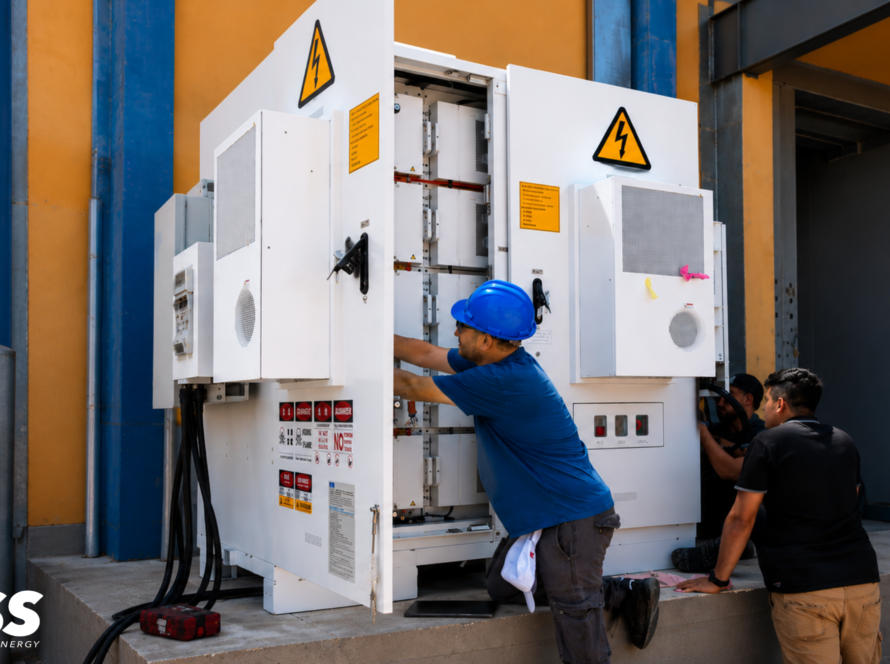
PAS 63100 explained, HSE guidance, BS 7671 Chapter 57 and where they each apply to a commercial battery installation in the UK.
There’s no single “battery storage fire safety act” in the UK — instead, a commercial installation has to satisfy several overlapping frameworks at once. PAS 63100 is a British Standards Institution specification written primarily for small-scale and domestic battery systems, but it’s widely used by installers and insurers as a fire-safety benchmark for smaller commercial sites too. BS 7671 Chapter 57 sets the electrical installation requirements for stationary batteries and becomes mandatory for new installs from 15 October 2026. Separately, general workplace law — enforced by the HSE — requires a fire risk assessment, safe electrical installation and, above certain thresholds, formal notification to your local fire and rescue service. Larger, grid-connected systems fall under additional NFCC guidance aimed at fire services. Which of these apply to your project, and how strictly, depends on the size and siting of your system.
Ask five installers what regulations apply to commercial battery storage fire safety in the UK, and you’ll likely get five slightly different answers — not because anyone is wrong, but because the framework genuinely is fragmented. Unlike solar PV, which has a mature, single set of installation standards, battery storage sits across product specifications, electrical wiring regulations, general workplace health and safety law, and fire service planning guidance, each written by a different body for a slightly different purpose.
That’s not a reason to treat fire safety loosely. Insurers, landlords and local fire and rescue services are all paying closer attention to battery installations, and getting the compliance picture wrong can mean a failed insurance claim or a stalled connection as much as a fire risk. This guide sets out what each framework actually covers, which ones apply to a typical commercial site, and what that means in practice when you’re specifying a system.
Solar PV benefits from decades of established wiring practice and a single dominant standard. Battery storage is newer, and the risk profile — thermal runaway in a sealed enclosure, rather than a straightforward electrical fault — is different enough that regulators have built the framework in layers: a product and installation specification, an electrical wiring standard, and separate workplace and fire service guidance, rather than one unified code.
Why there’s no single battery fire safety rulebook
A commercial battery installation typically has to satisfy compliance in three distinct layers, each policed by a different body. The first is product and design standards — specifications that set out how the battery itself, its enclosure and its management system should behave, chiefly PAS 63100. The second is electrical installation standards — the wiring rules that govern how the system is connected and protected, set out in BS 7671 and the IET’s supporting Code of Practice. The third is workplace and fire safety law — the general legal duties on any business with equipment on site, enforced by the HSE and, for fire risk specifically, under the Regulatory Reform (Fire Safety) Order 2005 for premises in England and Wales.
Grid-scale and larger open-air systems pick up a fourth layer: guidance from the National Fire Chiefs Council aimed specifically at how fire and rescue services plan for and respond to battery sites. Most commercial rooftop or building-mounted systems won’t trigger the full grid-scale guidance, but the principles it sets out — risk assessment, siting distances, and early engagement with the local fire service — are increasingly treated as good practice at smaller scales too.
What PAS 63100 actually covers
PAS 63100:2024 is a Publicly Available Specification published by the British Standards Institution, which came into effect on 31 March 2024. It was written to help reduce the risk of battery installations becoming a source of ignition, and to limit the impact of a fire if one does occur.
PAS 63100 is formally scoped to battery storage in dwellings, so it isn’t a legal requirement for a commercial premises in the way BS 7671 or workplace fire law are. In practice, though, many commercial battery systems — a cabinet on a warehouse wall, or a unit paired with rooftop solar on a small office — closely resemble domestic-scale installations, and installers, insurers and fire services increasingly reference PAS 63100’s provisions as the working benchmark for that scale of system, whatever the building type.
- Batteries sited away from escape routes, and outside rooms used for occupation where practical
- Enclosures that are fire-resistant, adequately ventilated and able to contain a fault for a reasonable period
- A battery management system capable of detecting and responding to fault conditions
- Clear separation between the battery installation and materials that could accelerate fire spread
Asking your installer to design against PAS 63100 even for a commercial system that technically sits outside its scope is a reasonable, low-cost way to raise the fire safety baseline — and it’s increasingly what insurers expect to see evidenced before they’ll price a policy that includes a battery installation.
BS 7671 Chapter 57 and the IET Code of Practice
Where PAS 63100 addresses the product and its siting, BS 7671 — the UK’s wiring regulations — governs how the battery is actually connected into the building’s electrical system. The current amendment, BS 7671:2018+A4:2026, introduces a dedicated Chapter 57 covering stationary battery installations, and compliance becomes mandatory for new installations from 15 October 2026. This is not optional guidance; it’s the standard your electrical installation certificate will be assessed against.
Alongside BS 7671, the IET’s Code of Practice for Electrical Energy Storage Systems gives more detailed, practical guidance on the questions Chapter 57 doesn’t fully spell out — separation distances between battery units and other equipment, ventilation design, and how to isolate a system safely for maintenance or in an emergency. A commercial installer working to both documents, rather than treating a battery as “just another piece of kit” wired to existing rules, is the clearest sign of a properly specified system.
| Standard | What it governs | Status for commercial sites |
|---|---|---|
| PAS 63100 | Product design, siting and enclosure fire safety | Voluntary benchmark, widely followed |
| BS 7671 Ch. 57 | Electrical installation of stationary batteries | Mandatory from 15 Oct 2026 |
| IET Code of Practice | Detailed design guidance for EESS | Industry best practice |
| HSE workplace regs | Legal duties on the operator/employer | Legally binding |
| NFCC guidance | Fire service planning and response | Primarily grid-scale, informs best practice |
HSE guidance and what the law actually requires
This is the layer that’s easiest to overlook, because it isn’t specific to batteries — it’s the general workplace health and safety law that already applies to your premises, extended to cover the new equipment. The Health and Safety Executive doesn’t issue a single “battery storage regulation,” but points to several existing regimes that apply once a battery system is on site.
The 25-tonne notification threshold is far above what a typical commercial rooftop or building-mounted system will hold, so it mainly concerns larger, warehouse-scale or grid-connected installations. Even where it doesn’t apply, the fire risk assessment duty under the RRO still does — for every commercial site, of any size.
NFCC guidance and when to involve the fire service
The National Fire Chiefs Council’s guidance on battery energy storage is written for fire and rescue services, primarily covering grid-scale, open-air lithium systems of 1MWh capacity or greater. If your project sits at that scale, early, structured engagement with your local fire and rescue service — including a documented risk assessment, an outline safety management plan and an emergency response plan — is effectively expected, even where it isn’t a formal condition of planning consent.
For a smaller commercial installation, the NFCC guidance won’t apply directly, but the underlying logic still holds: a fire and rescue service that knows a battery system is on site, and has basic information about its location and capacity, can respond faster and more safely if something does go wrong. Most installers arrange this notification as standard practice for commercial-scale systems, even where it isn’t a strict legal requirement.
Fire and rescue services have become noticeably more attentive to battery storage generally, following a small number of well-publicised incidents at larger UK sites. A commercial system that’s compliant on paper but that the local fire service has never heard about is a weaker position than one where a short heads-up has already been given.
- Battery and enclosure specified against PAS 63100, even if technically out of scope
- Sited away from escape routes and, where possible, occupied spaces
- Battery management system with fault detection and automatic response
- Installation designed to BS 7671 Chapter 57 ahead of the October 2026 deadline
- Design follows the IET Code of Practice for separation and ventilation
- Installer is MCS-certified and issues a compliant electrical installation certificate
- Fire risk assessment updated to reflect the new installation
- DSEAR and Electricity at Work Regulations considered in the design and O&M plan
- Local fire and rescue service made aware of the system, even where not formally required
- There’s no single law that covers commercial battery storage fire safety — it’s a stack of product, electrical and workplace standards.
- PAS 63100 is technically domestic-scoped but widely used as the benchmark for smaller commercial systems too.
- BS 7671 Chapter 57 becomes mandatory for new installations from 15 October 2026 — don’t leave design decisions until after that date.
- General workplace law, including the Fire Safety Order and DSEAR, applies to every commercial site regardless of scale.
- NFCC guidance targets grid-scale systems, but early fire service engagement is good practice at any size.
Whether your planned installation needs planning permission in the first place is a separate question from fire safety compliance — our guide to planning permission for commercial battery storage covers the permitted development position in detail.
Frequently asked questions
Related guides
Not sure if your battery system is compliant?
We’ll design and install to PAS 63100, BS 7671 Chapter 57 and the IET Code of Practice, and handle your fire risk documentation and fire service notification as part of the job.