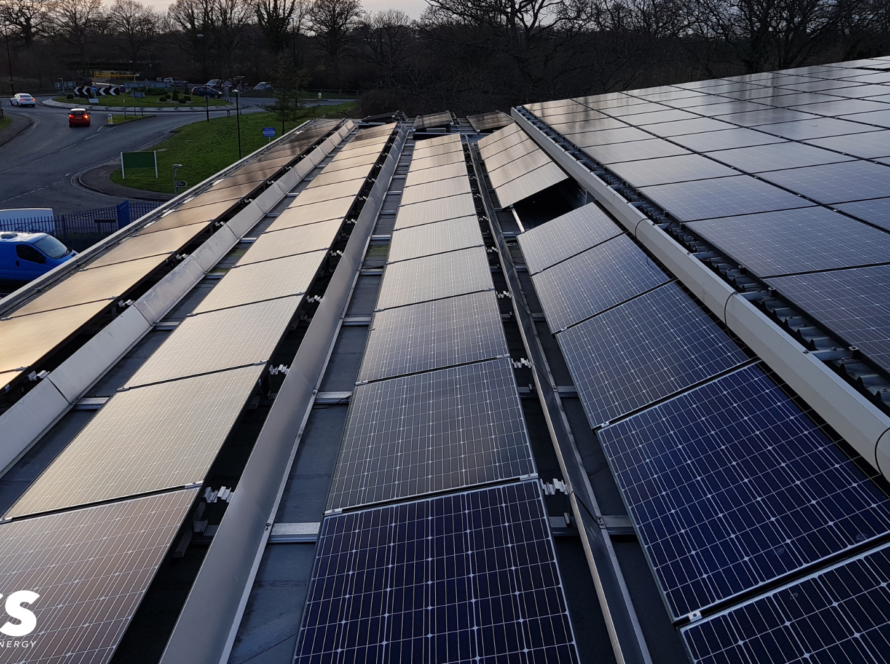
The same panels, a very different proposition. If you are evaluating solar for a business premises, here is what changes at commercial scale — and why those differences matter for your return on investment.
When comparing commercial vs residential solar panels, the core technology is the same — but almost everything else changes. System size, roof structure, grid connection, planning requirements, financial incentives, and the design methodology all differ significantly at commercial scale. The result is that commercial solar is typically a stronger financial investment than residential, with faster payback, larger absolute savings, and tax reliefs unavailable to homeowners — but it requires a specialist installer who understands the full commercial picture.
If you have been a homeowner with solar panels, you will arrive at a commercial solar conversation with a useful foundation — but also with some assumptions that do not transfer. Commercial vs residential solar panels is not simply a question of scale. The design methodology, the financial case, the planning environment, and the grid connection process all work differently for business premises.
Understanding those differences is the starting point for commissioning a commercial system that performs as well financially as it should. This guide sets out what changes, what stays the same, and — critically — what the differences mean for your return on investment.
A typical home installation runs between 4 and 6 kWp — enough to generate 3,500–5,200 kWh per year under UK conditions. That broadly covers the annual electricity consumption of a medium to large household. Roof space is the binding constraint on virtually every residential project.
Commercial systems typically start at 20–30 kWp and scale to 150 kWp or more on large warehouse and agricultural roofs. The available roof area on a commercial building — particularly a flat industrial or warehouse roof — is often orders of magnitude larger than any home, which changes both the economics and the engineering requirements entirely.
Larger systems carry lower per-kWp installation costs, benefit from bulk panel pricing, and produce savings at a scale that makes payback periods genuinely short.
Almost all residential installations use pitched roofs — typically tiled or slate. Panels are mounted on rails fixed directly to the roof structure, angled to match the existing pitch. The orientation of the roof largely determines the system’s performance.
Many commercial premises — warehouses, factories, retail units, office blocks — have flat or low-pitch roofs. These use ballasted mounting systems that sit on top of the roof membrane without penetrating it, which preserves the roof warranty and allows panels to be angled optimally regardless of the underlying roof orientation. Structural load calculations are required, and the roof’s condition and remaining lifespan must be assessed before any installation proceeds.
Systems up to 3.68 kW per phase can be connected under permitted connection rules with simple notification to the DNO. Most residential installations fall under this threshold and face no formal grid application process.
Commercial systems almost always exceed permitted connection thresholds and require a formal G99 application to the local DNO. The DNO assesses the impact on the local network and may require a protection relay, export limitation, or even grid reinforcement works in some cases. This process takes weeks to months and needs to be factored into the project timeline from the outset. A commercial installer manages this on your behalf — if a quote does not mention it, ask why.
DNO applications are not optional. Operating a commercial system without the correct grid connection approval is a regulatory breach with real consequences.
Residential design is relatively simple: fill the available south-facing roof space with as many panels as the budget allows. Consumption data plays a minor role because household demand is fairly predictable and the system is rarely large enough to generate significant surplus.
Commercial design starts with half-hourly smart meter data. The installer maps your actual consumption pattern — when you use electricity, how much, and how it varies by season — and overlays it against the generation profile for your roof orientation and location. The system is then sized to maximise self-consumption and financial return, not to fill every available square metre. Oversizing a commercial system generates surplus that earns only a fraction of what self-consumed electricity saves.
Most residential solar installations fall under permitted development rights and require no formal planning application, provided they meet size and visual impact criteria. Listed buildings and conservation areas are the main exceptions.
Commercial installations have their own permitted development rules. Roof-mounted systems on industrial and commercial premises are generally permitted up to certain thresholds, but ground-mounted systems, listed buildings, and sites in conservation areas or national parks typically require a formal planning application. Agricultural installations may also trigger additional considerations under permitted development for agricultural buildings. Your installer should clarify the planning position for your specific site before work begins.
Homeowners benefit from 0% VAT on solar installation and earn income via the Smart Export Guarantee on exported electricity. There are no further tax reliefs available — the investment is made from post-tax income with no capital allowance offset.
Businesses can deduct 100% of the capital cost from taxable profits via the Annual Investment Allowance in the year of installation — worth 25p of tax relief per pound invested at the current corporation tax rate. Commercial solar and battery storage are also exempt from business rates in England. These reliefs meaningfully reduce the effective net cost of a commercial system and improve payback speed in ways that have no equivalent in the residential market.
On a £120,000 commercial system, AIA at 25% corporation tax generates £30,000 in immediate tax relief. The net effective investment becomes £90,000 before the system generates a single unit of electricity.
We cover Essex, London, and the South East — our commercial solar installation service starts with a free, no-obligation site assessment.
The differences above are not just additional complexity — most of them translate directly into better financial outcomes than residential solar can achieve. The commercial solar benefits of operating at scale, with access to business-specific tax reliefs and a system designed around actual consumption data, make commercial solar one of the strongest capital investments available to UK businesses.
The commercial solar benefits above assume a system correctly sized to your consumption data. A system sized to roof space rather than demand — or quoted without a half-hourly smart meter review — will typically underperform these figures. The design methodology is where the financial case is won or lost, before a single panel is installed.
The additional complexity of a commercial installation — DNO applications, structural assessments, three-phase inverter design, commercial-grade battery integration, and consumption-based sizing — means that the quality of the installer has a proportionally larger impact on outcome than it does at residential scale.
A residential system installed by a competent but generalist installer will usually perform acceptably. A commercial system installed by an installer without genuine commercial experience may be incorrectly sized, under-specified on the grid connection, or designed without reference to your actual consumption pattern. Any of those errors costs money — either in reduced savings over the lifetime of the system, or in additional works to correct the installation.
The right commercial installer will carry MCS certification, have verifiable commercial project experience, manage the DNO process on your behalf, review your half-hourly smart meter data before producing a design, and present the savings case for solar and battery separately — so you can make a genuinely informed investment decision rather than accepting a combined figure that makes both elements look better than they are individually.
We have completed over 300 commercial installations since 2017, across warehouses, offices, retail units, farms, and schools. Every project starts with a half-hourly consumption review and a site survey — not a rule-of-thumb quote. Our commercial solar battery storage service is available across Essex, London, Kent, Surrey, and Hertfordshire.
- When comparing commercial vs residential solar panels, the technology is the same — but system size, roof type, grid connection, planning, design methodology, and financial incentives all differ significantly.
- Commercial solar benefits include faster payback (3–5 years vs 8–12 for residential), larger absolute savings, AIA tax relief, business rates exemption, and credible sustainability credentials.
- Commercial design must start from half-hourly consumption data, not roof space. A system sized to your available roof rather than your actual demand will underperform its financial potential.
- DNO notification and grid connection are non-negotiable requirements for commercial systems — they must be managed by your installer as part of the project scope.
- Battery storage makes a stronger incremental case at commercial scale than residential — particularly for businesses with demand outside peak solar hours and those on time-of-use tariffs.
- Installer quality matters more commercially — the additional complexity of a commercial project amplifies the consequences of design errors in ways that residential projects rarely face.
Commercial solar designed around your business — not a generic template
We start every project with a half-hourly consumption review and a no-obligation site assessment. No guesswork. No rule-of-thumb sizing. Just a clear, site-specific return on investment.