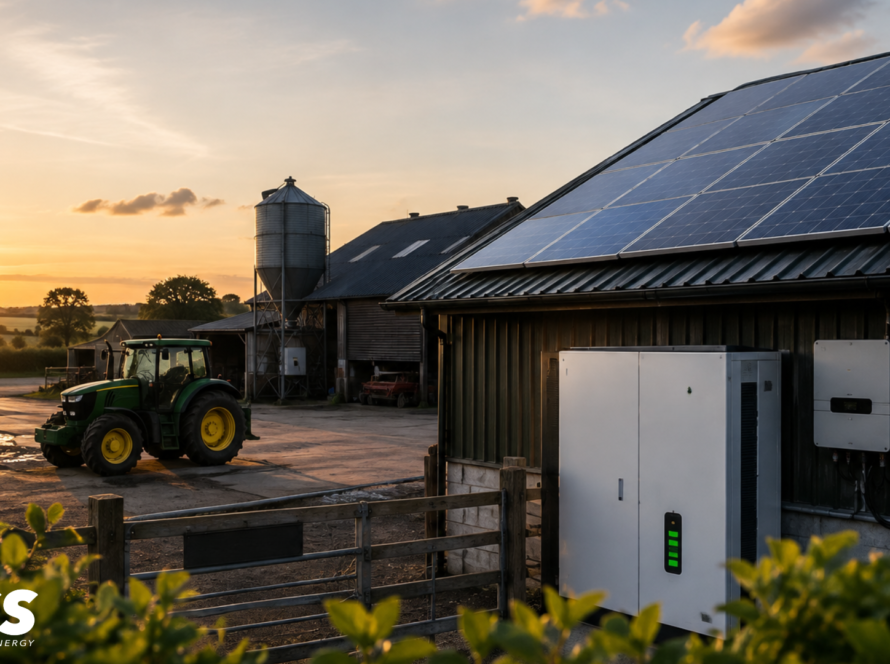
Prices have fallen sharply. Electricity rates have not. Here is what commercial battery storage genuinely costs in 2026, what you get for it, and how to decide whether it is right for your business.
Commercial battery storage costs between £18,000 and £85,000 in 2026 depending on capacity, with the majority of business installations falling in the 50–100 kWh range at £26,000–£48,000 fully installed. After the Annual Investment Allowance reduces the effective net cost by up to 25%, most systems deliver additional annual savings of £1,500–£3,500 on top of solar-only returns — making payback on the storage element around 6–10 years in isolation, or 4–6 years as part of a combined solar and battery system.
If you have been researching commercial solar battery storage, you will have noticed that quoted prices vary widely — sometimes by tens of thousands of pounds for what appears to be a similar system. That variation is real, and it reflects genuine differences in capacity, battery chemistry, inverter specification, and installation complexity rather than just margin differences between installers.
This guide cuts through that noise. It sets out what you can expect to pay in 2026, what factors move the price up or down, how tax relief changes the net cost, and — most importantly — whether adding battery storage to your commercial solar energy system is the right financial decision for your business.
The headline figure on a battery storage quote is shaped by four main variables. Understanding each one helps you compare quotes accurately and avoid being misled by headline capacity figures that do not reflect what you actually get.
Usable capacity (kWh) is the primary cost driver. More storage means more cost — but the relationship is not perfectly linear. Larger systems benefit from lower per-kWh pricing and shared installation costs, so the unit rate tends to fall as capacity increases. Always ask for the usable capacity figure specifically, not the total rated capacity. A battery rated at 100 kWh with 80% depth of discharge gives you 80 kWh usable; one rated at 100 kWh with 90% depth of discharge gives you 90 kWh. Comparing quoted prices without comparing usable kWh is comparing different products.
Battery chemistry affects both price and longevity. Lithium iron phosphate (LFP) is the dominant chemistry in commercial installations today. It costs more per kWh than older lithium-ion chemistries but delivers better cycle life (4,000–6,000 cycles versus 2,000–3,000), better thermal stability, and longer warranty terms. For a commercial investment that needs to perform over 10–15 years, LFP is the right choice — and the price premium is well justified.
Inverter specification adds cost that does not appear in the battery price alone. The inverter controls how power flows between panels, battery, and grid. A hybrid inverter that manages all three simultaneously costs more than a basic charge controller but allows smarter energy management and, on supported models, backup power capability. Quotes that separate battery and inverter costs can look cheaper at the headline level than all-in quotes covering the same scope.
Installation complexity varies by site. A single-phase commercial site with a modern consumer unit and easy cable routing costs less to install than a three-phase industrial site requiring DNO notification, switchboard upgrades, and long cable runs. A site survey is the only way to assess this accurately — any quote produced without one should be treated with caution.
When you receive multiple quotes, check that each one states: usable kWh (not total rated capacity), battery brand and chemistry, inverter brand and model, whether DNO notification is included, and the warranty terms for both battery and inverter. A lower headline price that excludes grid connection work or uses a shorter-warranty battery is not a like-for-like comparison.
The figures below are based on fully installed supply-and-install costs from commercial solar battery storage projects in Essex and the South East in 2026. They include the battery units, hybrid inverter, installation labour, commissioning, and DNO notification. They do not include any structural works, switchboard upgrades beyond standard requirements, or scaffolding where access is restricted.
| Usable capacity | Installed cost (2026) | After 25% AIA relief | Best suited to |
|---|---|---|---|
| 30–50 kWh | £18,000–£28,000 | £13,500–£21,000 | Small offices, retail units, schools on 20–50 kWp solar systems |
| 50–100 kWh | £26,000–£48,000 | £19,500–£36,000 | Mid-size commercial premises, larger retail, GP surgeries, warehouses on 50–100 kWp systems |
| 100–200 kWh | £45,000–£85,000 | £33,750–£63,750 | Large commercial sites, industrial units, agricultural operations on 100 kWp+ systems |
| 200 kWh+ | From £80,000 | From £60,000 | Large warehouse, multi-unit, or grid services applications — modelled individually |
Battery storage prices have been falling at roughly 10–15% per year. Waiting for further price reductions is understandable, but electricity import rates have been rising at a comparable rate. The net financial position of acting now versus waiting 12 months is typically neutral at best — and negative if you factor in a year of higher energy bills in the interim.
We review your half-hourly consumption data and model the storage case before recommending a size — no guesswork, no rule of thumb.
The sticker price of a commercial battery storage system is not the price your business actually pays. Three tax positions apply to most UK commercial installations and together they meaningfully reduce the effective net cost.
Annual Investment Allowance (AIA) allows 100% of the capital cost of a qualifying commercial battery storage system to be deducted from taxable profits in the year of installation — up to the current £1 million AIA limit. At the current 25% main corporation tax rate, a £40,000 battery system generates a £10,000 immediate tax saving, reducing the net effective cost to £30,000. For businesses paying the 25% rate, the AIA effectively takes a quarter off every pound invested in qualifying plant and machinery.
Business rates exemption removes what would otherwise be an ongoing annual property tax on the added value a solar and battery installation brings to a commercial premises. Both the generation system and the storage system are exempt in England, so there is no recurring rates liability on the investment.
Zero-rate VAT applies to battery storage systems installed at the same time as solar panels, or retrofitted to a qualifying existing solar installation. At 20% of the pre-VAT price, this is a significant saving — and one that is already priced into the figures above. Confirm the current VAT treatment with your accountant before committing, as HMRC rules on energy products are subject to revision.
Gross installed cost: £38,000 (0% VAT already applied). AIA relief at 25% corporation tax: £9,500. Net effective cost: £28,500. Additional annual savings over solar alone: approximately £2,200/yr. Payback on the battery element: approximately 13 years in isolation — or around 5 years as part of a combined system where the solar panels themselves return £8,000–£12,000/yr in savings. Always model both elements together, not the battery in isolation.
The benefits of battery storage are real — but so are the limitations. A fair assessment of the battery storage pros and cons for commercial sites needs to acknowledge both, because the right decision depends on your specific consumption pattern, your tariff, and your business goals.
- Higher self-consumption — stores surplus solar generation for use after dark or before dawn, lifting self-consumption from around 40% to 65–80%
- Avoided import cost — every kWh discharged from battery instead of bought from the grid saves 20–35p at current commercial rates
- Grid arbitrage potential — on time-of-use tariffs, charge overnight at off-peak rates and discharge during peak periods for a second layer of savings
- Power resilience — backup-capable systems maintain critical circuits during grid outages, preventing costly downtime
- AIA tax relief — 100% first-year deduction reduces the effective net cost by 25% at current corporation tax rates
- Future-proofing — correctly sized storage capacity accommodates EV fleet charging and load growth without additional grid infrastructure
- Higher upfront investment — adds £18,000–£85,000 to the solar project cost, extending total payback versus panels alone
- Lower incremental return for high daytime users — warehouses and industrial sites already self-consuming 60–75% of generation see smaller additional gains
- Capacity degrades over time — LFP batteries lose a portion of usable capacity across their cycle life; warranties typically guarantee 70–80% of original capacity at year 10
- Backup requires specific inverter design — standard grid-tied systems shut down during power cuts; island mode capability must be specified from the outset
- Space requirement — a 100 kWh system needs 2–4 floor-standing cabinets in a controlled, ventilated space; not all sites can accommodate this easily
- Tax positions can change — AIA limits and VAT treatment of energy products are set by government and subject to revision; always confirm with your accountant
The direct answer is: it depends on your demand profile, and no honest installer should tell you otherwise without reviewing your consumption data first.
Is commercial battery storage worth it for your business? The question resolves to one underlying calculation: how much of your electricity currently falls outside your solar generation window, and what does buying that electricity from the grid cost you? The larger that figure, the stronger the case for storage.
For offices, retail businesses, and hospitality venues — where trading hours extend beyond peak solar output and early morning loads pre-date meaningful generation — battery storage consistently improves the financial case and often shortens whole-system payback by 6–18 months. The combination of avoided import cost and grid arbitrage on a time-of-use tariff produces additional annual savings of £1,500–£3,500 on a 50–100 kWh system. For those businesses, the answer is usually yes.
For warehouses, logistics operations, and heavy industrial sites with continuous and high daytime electricity demand, the panels themselves already capture a large proportion of generation in real time. Self-consumption without storage can reach 60–75%. A battery still adds value — particularly for out-of-hours shifts or resilience — but the incremental financial return is smaller, and a panels-first approach with storage added as a second phase is often the more rational sequence.
For any business, commercial solar battery storage in Essex and across the South East is only worth commissioning once your half-hourly smart meter data has been reviewed and the additional savings case has been modelled against your specific tariff. A good installer builds that analysis into every site survey and presents the battery return separately from the solar return — so you can make a genuinely informed decision, not one based on a combined figure that obscures what each element contributes.
- Strong yes — if your business operates significantly outside daylight hours, or you want resilience against grid outages
- Likely yes — if you are on or moving to a time-of-use commercial tariff with meaningful peak and off-peak rate differences
- Panels first, review later — if your daytime loads are very high and you want the fastest possible initial payback before committing further capital
- Always — have your half-hourly consumption data modelled before committing. The right answer is in your smart meter data, not in a rule of thumb
- Most commercial battery storage systems cost £26,000–£48,000 fully installed in 2026 for the 50–100 kWh range that suits mid-size commercial sites.
- The Annual Investment Allowance cuts the effective net cost by 25% at current corporation tax rates — confirm the position with your accountant before committing.
- The benefits of battery storage are strongest for businesses with significant demand outside solar generation hours: offices, retail, hospitality, and any site needing backup power resilience.
- The battery storage pros and cons balance differently depending on your consumption profile — high daytime users often achieve better returns from panels alone first.
- Is commercial battery storage worth it? For most businesses asking the question, the answer is yes — but only a site-specific consumption analysis with your actual smart meter data gives you a reliable answer.
Get a site-specific storage assessment — free, no obligation
We review your consumption data, model the battery case against your actual tariff and usage, and give you a clear payback figure before you commit to anything. No jargon, no pressure.