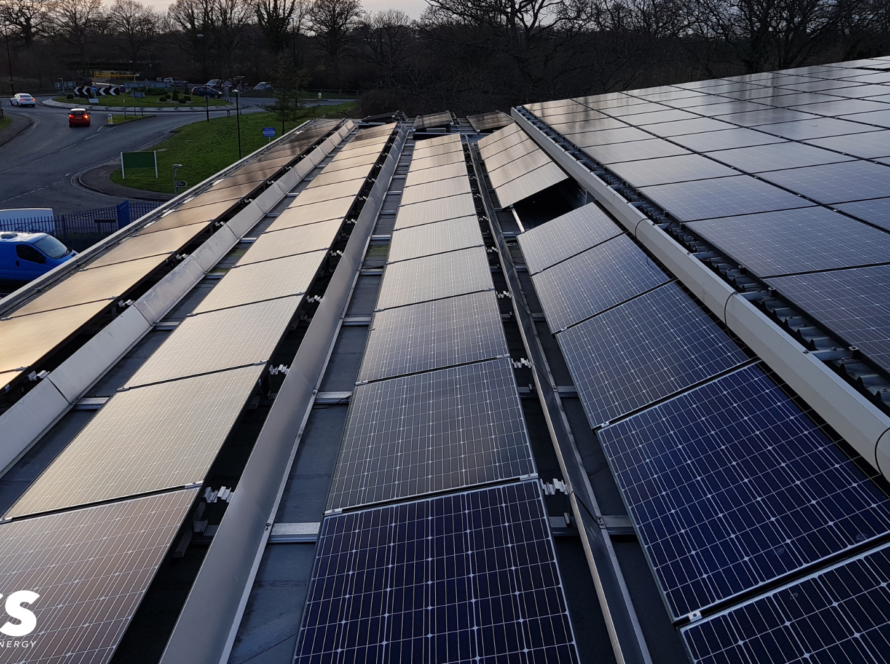
How battery storage for EV fleet charging business operations gets around depot grid constraints, works alongside Depot Charging Scheme funding, and avoids grid upgrade costs.
Battery storage for EV fleet charging works by acting as a buffer between your depot’s existing electricity supply and your chargers, so vehicles can charge at high power without your business needing the full grid capacity that charging them simultaneously would otherwise require. The battery charges slowly, from the grid and often solar, over hours when demand is low, then discharges quickly to support fleet charging during the return-to-depot window — letting you run more chargers, or higher-powered ones, on a connection that would otherwise be too small. This matters because grid capacity, not charger cost, is now the single biggest barrier fleet operators hit when electrifying, and it’s also directly relevant to funding: the government’s Depot Charging Scheme requires applicants to demonstrate sufficient grid capacity at the depot, which a battery can help satisfy without waiting years for a costly DNO reinforcement.
Every fleet operator planning electrification eventually runs into the same wall: it isn’t the vehicles, and it isn’t usually the chargers themselves — it’s the electricity supply into the depot. Charging a dozen vans or a handful of HGVs simultaneously at high power draws far more electricity than most depots were ever built to supply, and increasing that supply through the local Distribution Network Operator can take months or years, if capacity is available at all.
This guide explains where that constraint actually comes from, how battery storage solves it in practice, how it interacts with Depot Charging Scheme funding, and what fleet operators need to know about sizing a system correctly for their own depot.
Businesses budget carefully for chargers and vehicles, but grid capacity often isn’t discovered as a constraint until well into the project — sometimes only once a connection application comes back from the DNO with a multi-year reinforcement timeline attached. Investigating grid capacity early, alongside the chargers themselves, avoids a costly late-stage surprise.
Most depots were connected to the grid decades ago, sized for lighting, offices and light industrial equipment — not for charging a fleet of vehicles that each want tens of kilowatts simultaneously the moment they return from a shift. A single high-power HGV charger alone can draw more than an entire depot’s existing supply was ever designed to deliver, and a fleet of vans charging together compounds that many times over.
Increasing your depot’s available capacity means applying to your Distribution Network Operator for a larger connection — a process that, in constrained areas, can take anywhere from several months to multiple years, and can carry a significant reinforcement cost if the local substation or cabling needs upgrading to support it. For a fleet operator on a tight electrification timeline, that delay alone can derail a project regardless of budget.
Grid capacity has become such a common bottleneck for fleet electrification that the Depot Charging Scheme itself requires applicants to demonstrate sufficient grid capacity at the depot as one of its eligibility conditions — meaning the constraint isn’t just a technical detail, it can directly affect whether your funding application succeeds.
A commercial battery installed at the depot acts as a buffer between the grid connection and the chargers. Rather than every charger drawing directly from the grid at the moment vehicles plug in, the battery charges gradually throughout the day or overnight — well within the depot’s existing supply capacity — and then discharges at a much higher rate during the charging window itself, supplementing what the grid connection alone could deliver.
Every charger’s peak power draw adds directly to what the grid connection needs to supply at once. A depot wanting to charge 10 vans at 22kW simultaneously needs a connection capable of delivering that full combined load the instant they all plug in — regardless of how briefly that peak actually lasts.
The battery charges slowly across a longer window — hours rather than minutes — using only a fraction of the peak demand, then discharges rapidly to support the chargers during the actual charging event. The grid connection only ever needs to supply the battery’s charging rate plus any base load, not the full simultaneous peak of every vehicle charging at once.
The Depot Charging Scheme is a UK government grant programme supporting fleet operators installing charging infrastructure at their depots for zero-emission vans, HGVs and coaches. It forms part of a £170 million multi-year funding programme running from 2026 to 2030, itself part of a wider £1 billion-plus government commitment to fleet electrification.
| Detail | Current window |
|---|---|
| Funding rate | Up to 70% of eligible chargepoint and civil costs |
| Maximum grant | £1 million per organisation, across all sites |
| Applications per organisation | One, but can cover multiple depot sites |
| Key eligibility condition | Must demonstrate sufficient grid capacity at the depot |
| Next application window | Opens 28 October 2026, for 2027/28 delivery |
The grid capacity requirement is where battery storage becomes directly relevant to the funding itself, not just to the technical design. If your depot’s existing connection can’t support your planned charging load, a battery system can be the difference between meeting that eligibility condition and needing to wait on a DNO upgrade before you can even apply. Since eligible costs under the scheme cover chargepoint and civil engineering works, it’s worth discussing with your installer and, where relevant, your grant advisor exactly how battery storage costs are treated within your specific application.
Applications are assessed on a first-come, first-served basis, and the current window’s allocated funding can be exhausted before the published closing date. Businesses considering an application should get their grid capacity position — including whether battery storage is part of the plan — confirmed early rather than leaving it until close to a deadline.
A DNO-led grid reinforcement to support a fleet depot’s full charging load can be one of the largest and slowest line items in an electrification project — sometimes running into hundreds of thousands of pounds and well over a year in constrained network areas. Battery storage offers a genuine alternative path in many cases, not just a stopgap.
- Buffers peak charging demand so the existing connection only needs to supply an averaged load
- Can be installed and commissioned in weeks to months, versus months to years for network reinforcement
- Pairs with solar generation to reduce ongoing running costs on top of solving the capacity problem
- Scales incrementally as fleet size grows, rather than requiring a single large upfront reinforcement
- Can still be combined with a modest grid upgrade where some additional capacity is genuinely needed, reducing the size and cost of that upgrade
It’s worth being realistic that battery storage doesn’t remove the need for grid connection entirely — a G99 application for the battery and charging infrastructure is still generally required. But it changes the scale of what needs to be approved, often turning a multi-year reinforcement project into a standard connection application. For a full breakdown of that process, see our guide on UK Power Networks G99 applications for battery storage.
Fleet charging batteries are sized differently to batteries designed purely for building self-consumption — the priority is peak power delivery over a specific charging window, not simply total stored energy.
The right starting point is a site-specific assessment of your depot’s existing grid connection, planned fleet size, and charging pattern — rather than sizing a battery from a generic assumption. This is exactly the kind of assessment we carry out for fleet operators, and where relevant, we help map the outcome against current Depot Charging Scheme funding windows.
For businesses running fleet depots in Essex, our commercial solar battery storage for Essex fleets service covers site assessment, battery sizing and grid connection management specifically for fleet charging projects.
- Current depot connection capacity confirmed with your supplier or DNO
- Planned simultaneous charging load calculated against that existing capacity
- Any DNO reinforcement timeline and cost estimate obtained for comparison
- Current and planned fleet size, with expected charging windows mapped out
- Depot ownership or landlord consent confirmed for infrastructure works
- At least one battery-electric vehicle owned, leased or ordered, if applying for DCS funding
- Current Depot Charging Scheme window and deadline checked
- Battery storage costs discussed with your grant advisor as part of the application
- Site assessment booked to confirm accurate sizing before committing to a design
- Grid capacity, not charger cost, is usually the real constraint on fleet depot electrification.
- Battery storage buffers peak charging demand, letting more vehicles charge on the same grid connection.
- The Depot Charging Scheme requires demonstrating sufficient grid capacity — a battery can help meet that condition.
- Battery installation is typically far faster than a full DNO network reinforcement.
- Sizing should be based on your fleet’s actual charging pattern, not a generic assumption.
Planning to electrify your fleet?
We’ll assess your depot’s grid capacity, size a battery system around your actual charging pattern, and help you understand how it fits with current Depot Charging Scheme funding.