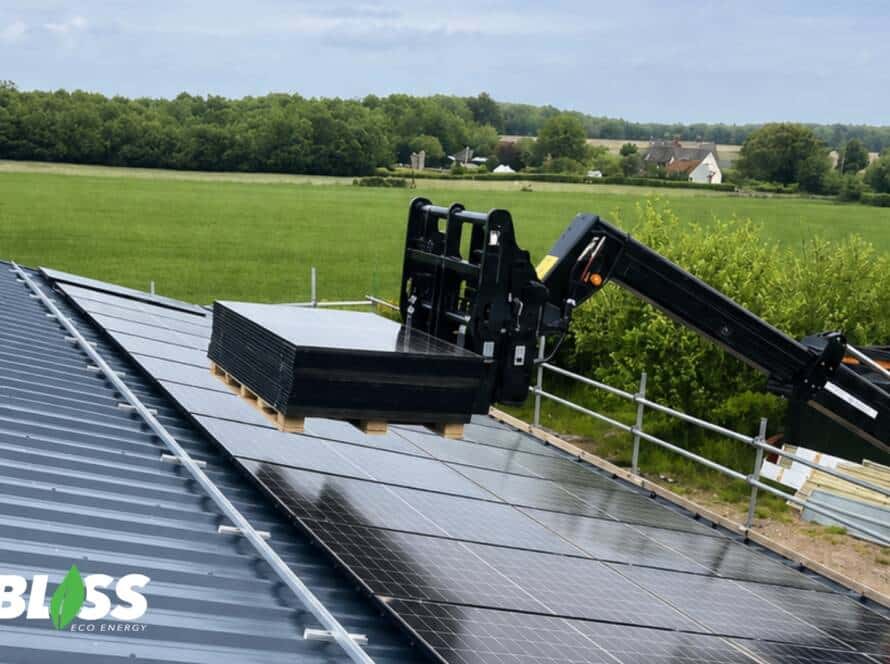
For many Essex manufacturers, electricity is one of the top three operating costs — and unlike labour or materials, most businesses are not actively managing it. Commercial battery storage and solar change that equation, sometimes dramatically.
For Essex manufacturers spending £60,000–£200,000 per year on electricity, a combined commercial solar and battery storage system typically saves £18,000–£55,000 per year — through lower import costs, reduced demand charges, and DUoS charge avoidance. With the Annual Investment Allowance reducing the effective net cost by 25% in year one, payback periods of 3–5 years are achievable even on industrial sites where continuous daytime loads limit how much surplus is available to store.
Energy costs for Essex manufacturers have risen sharply and persistently since 2021. The unit rate increase is well understood — but the less visible components of an industrial electricity bill have risen just as significantly, and they respond to a different set of interventions. Understanding what is actually driving your electricity spend is the starting point for knowing what a solar and battery storage investment can realistically change.
This guide is written specifically for Essex manufacturing and industrial businesses — from light engineering and food processing to plastics, print, and metal fabrication. The energy profile of a manufacturing site is different from an office or retail unit, and the solar and battery storage case needs to reflect that.
Manufacturing electricity prices in 2026 for UK industrial consumers sit at an average of 25–32p/kWh including all non-commodity charges — roughly 55–70% higher than in 2020. The increase has not reversed, and the forward curve for commercial electricity rates does not show a return to pre-2021 levels within any reasonable planning horizon. For a manufacturer consuming 500,000 kWh per year, the difference between 2020 and 2026 rates represents an additional £35,000–£50,000 in annual energy spend at current consumption levels.
What has changed most significantly is not just the unit rate but the distribution of costs within the bill. Network charges — the cost of maintaining and using the electricity distribution infrastructure — have risen as a proportion of the total, and they are particularly sensitive to how a manufacturing site draws power, not just how much it uses. A site that draws power in large, sudden bursts pays proportionally more in network charges than one with a smooth, continuous load at the same total consumption. This is where battery storage offers its most distinctive value for manufacturers.
On a manufacturing site, a commercial battery storage system works across three distinct mechanisms simultaneously — and unlike office or retail deployments, the peak shaving and demand charge reduction mechanisms are often more financially significant than the self-consumption savings from solar.
The solar self-consumption element is well understood: panels generate during the day, the battery stores what the factory cannot absorb in real time, and that stored energy is used during shift transitions, break periods, or before generation starts in the morning. For a manufacturer running a relatively continuous daytime load, real-time self-consumption can already be high — often 65–80% without any storage. The battery’s role is to capture what escapes that window.
Peak shaving is where a manufacturing battery earns most of its additional value over a solar-only system. By pre-charging from either solar surplus or cheap overnight grid electricity and discharging during machinery start-ups, high-draw process peaks, or DUoS Red Band windows, the battery prevents the demand spikes that set maximum demand charges and accumulate DUoS costs. A well-sized battery, correctly configured to the site’s half-hourly demand profile, can reduce maximum demand charges by 20–40% — a saving that compounds every billing period for the life of the system.
For manufacturing sites, the battery sizing decision is driven by the demand profile, not the solar array size. A factory running two shifts has out-of-hours demand that extends well beyond solar generation hours — and the battery that covers the evening shift transition and the DUoS Red Band exposure is more valuable than one sized to capture lunchtime solar surplus. Half-hourly data from your smart meter is the only reliable input for this calculation.
High-draw CNC machinery, welding equipment, and press brakes create significant demand spikes at start-up and during intensive processes. These are exactly the peaks a battery addresses most effectively. Combined solar and battery systems on Essex engineering sites typically save £20,000–£45,000/yr on electricity bills of £80,000–£160,000, with maximum demand charge reductions often among the largest single savings line.
Refrigeration and temperature-controlled storage create a high, continuous baseload that solar can offset reliably throughout generation hours. Battery storage adds value by covering early-morning pre-generation loads, reducing DUoS Red Band costs during evening operations, and — critically — providing power resilience during grid outages that would otherwise risk product loss. Battery storage with backup capability is particularly compelling for food businesses where a grid fault has direct financial and reputational consequences.
Large format printing, injection moulding, and extrusion lines draw significant power during warm-up and high-speed production cycles. These operations often run extended shifts that push deep into DUoS Red Band periods. A battery discharging during the 4pm–7pm DUoS window can save £8,000–£15,000/yr on DUoS charges alone for a medium-size print or plastics operation, independently of the solar self-consumption benefits.
Large flat roofs, high lighting loads, forklift charging, and refrigerated dock areas make logistics sites among the strongest performers for combined solar and storage in Essex. The battery covers early-morning dock activity before solar generation peaks, absorbs surplus generation during quieter midday periods, and deploys it into the high-activity end-of-day window. Forklift fleet electrification further strengthens the case — charging from stored solar generation rather than the grid adds a compounding saving as fleet sizes grow.
We review your half-hourly data and model the solar, battery, and demand charge savings specific to your site, shift pattern, and tariff.
The example below is based on a typical mid-size Essex engineering and fabrication business — around 40 employees, operating Monday–Friday with occasional Saturday morning shifts. Annual electricity consumption approximately 420,000 kWh, annual electricity bill approximately £118,000 before any renewable investment.
These are illustrative estimates based on Essex solar irradiance data and typical engineering site consumption profiles. Actual savings depend on your half-hourly demand data, your tariff structure, your shift pattern, and your roof orientation. We model site-specific figures for every project before any commitment is made.
Manufacturing sites with battery systems above 50 kWh are also eligible to participate in grid services programmes — Dynamic Containment, the Demand Flexibility Service, and tariff arbitrage — through aggregator platforms. For a 120 kWh manufacturing battery, this can add a further £2,000–£5,000/yr in grid services revenue on top of the energy savings modelled above.
The key consideration for manufacturers is that grid services activity must not compromise the peak shaving function that the battery is primarily there to perform. A battery depleted by overnight grid services dispatch before a morning machinery start-up is failing its primary job. The right aggregator contract and energy management configuration preserves peak shaving priority and uses remaining capacity for grid services — not the other way around.
For a full breakdown of the grid services income available to commercial battery sites, our guide to Can Your Battery Storage System Earn You Money From the Grid? covers Dynamic Containment, DFS, and tariff arbitrage in detail.
| Saving / revenue stream | Mechanism | Typical annual value (Essex mfg site) | Requires battery? |
|---|---|---|---|
| Solar self-consumption | Avoids grid import at 25–32p/kWh | £20,000–£35,000/yr | No — but battery improves it |
| Maximum demand reduction | Peak shaving reduces MD charge trigger | £5,000–£18,000/yr | Yes |
| DUoS Red Band avoidance | Battery discharges during 4pm–7pm window | £3,000–£12,000/yr | Yes |
| Tariff arbitrage | Overnight cheap charge, peak discharge | £1,000–£3,500/yr | Yes |
| Dynamic Containment (aggregated) | Availability payment from National Grid ESO | £1,200–£3,400/yr | Yes + aggregator |
| Demand Flexibility Service | Event-based demand reduction payments | £800–£2,400/yr | Yes + aggregator |
- Energy costs for Essex manufacturers have risen 55–70% since 2020 and show no sign of reversing. Solar and battery storage is one of the few interventions that cuts both the unit cost and the network cost components of the bill simultaneously.
- Manufacturing electricity prices in 2026 mean a 420,000 kWh site is spending over £117,000/yr on electricity — making even a 30–40% reduction through solar and storage worth £35,000–£47,000/yr.
- For energy-intensive industries in Essex, peak shaving and DUoS Red Band avoidance are often more valuable than solar self-consumption alone — these are the cost drivers that respond most directly to a correctly configured battery.
- Maximum demand charges — which can represent 15–25% of a manufacturing site’s total bill — are directly reduced by a battery that smooths demand peaks at machinery start-up and during high-draw process cycles.
- The AIA tax relief at 25% corporation tax reduces the effective net cost of the combined system by 25% in year one — bringing a £165,000 combined solar and battery investment down to an effective £123,750 before energy savings begin.
- Grid services income from Dynamic Containment and the Demand Flexibility Service can add a further £2,000–£5,800/yr on top of energy savings for manufacturing batteries above 50 kWh — provided peak shaving priority is preserved in the energy management configuration.
Speak to us about your Essex manufacturing site
We review your half-hourly demand data, identify your biggest cost drivers, and model a solar and battery solution sized to your shift pattern, tariff, and roof. No guesswork — just site-specific numbers.