How Many Solar Panels Will Fit on My Roof?
In today’s world, solar energy is rapidly gaining popularity across the UK. More homes and businesses are turning to this renewable power source to save on electricity bills and make a positive impact on the environment. Installing a solar panel kit with a battery and an inverter is one of the smartest ways to gain energy independence. With Bliss Eco Energy, the process is simple, efficient, and professionally managed.
But one of the most common questions we receive is: “How many solar panels will fit on my roof?” Understanding your roof’s solar potential is crucial for designing a system that maximises energy generation and long-term savings.
This guide breaks down the key factors, calculations, and professional considerations you need to know to determine your roof’s solar capacity.
What Determines How Many Solar Panels Will Fit on My Roof?
Several key factors influence how many solar panels your roof can accommodate:
- Roof Size and Shape
- Panel Size and Efficiency
- Roof Orientation
- Sunlight Access and Shading
- Tilt Angle
- Energy Goals and Battery Storage
- Professional Assessment

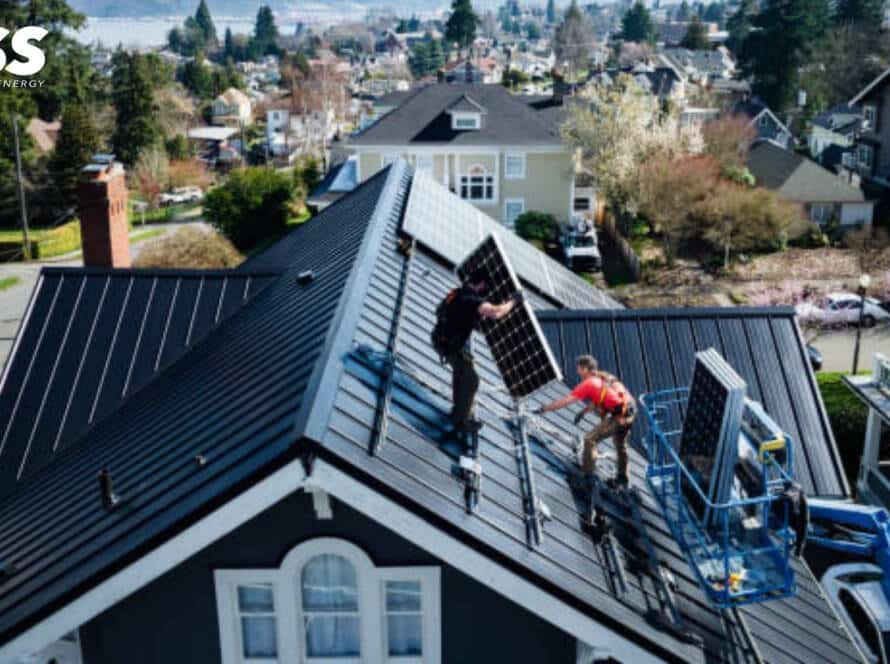
Measure Your Roof Space
Most UK homes have 20–50 m² of usable roof space. To calculate your roof area:
- Measure the length and width of each usable roof section.
- Multiply length × width to get the area in square metres.
- Subtract shaded or obstructed areas (chimneys, skylights, vents).
This gives you the usable roof area for solar installation.
Consider Panel Type and Efficiency
Not all panels are equal. Standard panels generate 350 – 450 watts, while premium models can produce more in the same space.
Choosing high-efficiency panels means fewer panels are required to achieve the same output, ideal for smaller roofs or complex shapes. Bliss Eco Energy provides panels optimised for UK weather conditions, ensuring durability, performance, and long-term ROI.
Example Calculation
Let’s say your roof has 40 m² of usable space. Standard panels need roughly 1.7 m² each:
40 ÷ 1.7 ≈ 23 panels
This installation would provide roughly 8–9 kW of power, sufficient for an average UK home.
Average Roof Size vs. Solar Panel Capacity
| Roof Area (m²) | Approx. Panels | System Size (kW) | Annual Output (kWh) | Suitable Home Size |
|---|---|---|---|---|
| 20 m² | 11–12 | 4 kW | 3,400–4,000 | Small Home |
| 30 m² | 17–18 | 6 kW | 5,100–6,000 | Medium Home |
| 40 m² | 23–24 | 8 kW | 6,800–7,800 | Large Home |
| 50 m² | 29–30 | 10 kW | 8,500–9,500 | Large Family Home |
Account for Roof Direction and Tilt
In the UK, south-facing roofs are most efficient, capturing maximum sunlight throughout the year. Tilt angles between 30° and 40° are optimal. For flat or less angled roofs, mounting frames can adjust tilt to improve performance.
Think About Battery Storage
Installing a battery system with your solar kit means no energy goes to waste. Excess energy produced during the day is stored for nighttime use, boosting your self-sufficiency and long-term savings.
A solar battery allows you to store excess energy produced during the day for use at night or during cloudy periods.
Benefits include:
- Reduced reliance on the grid
- Lower electricity bills
- Energy security during outages
- Better long-term ROI
Pairing your solar system with a battery ensures you make the most out of every ray of sunlight that hits your roof.
Use Professional Assessment
At Bliss Eco Energy, our specialists evaluate every aspect of your roof in detail, taking into account size, shape, orientation, shading, and your energy goals. They can also provide precise recommendations for panel quantity, layout, and system type, ensuring you get the maximum energy output efficiently.
Bliss Eco Energy specialists consider:
- Roof dimensions and shape
- Orientation and shading
- Energy consumption goals
- Panel efficiency and layout
- Battery storage options
This ensures your solar installation is optimised for both energy production and cost-effectiveness.
Choosing the Right Solar Panels
Not all panels perform equally. High-efficiency solar panels generate more electricity per square metre, allowing you to achieve greater power even on smaller roofs.
For instance, while a standard 350W panel might generate a certain output, a 450W high-efficiency panel could increase total production by up to 20% without taking extra space.
This is why Bliss Eco Energy focuses on premium-quality panels designed for the UK’s weather conditions, ensuring durability, performance, and long-term return on investment.
Conclusion
So, how many solar panels will fit on your roof? The answer depends on a combination of factors: roof size, panel efficiency, orientation, and energy needs.
With professional guidance from Bliss Eco Energy, homeowners can confidently plan and install a system that delivers maximum energy, savings, and sustainability.
By leveraging modern technology and expert engineering, Bliss Eco Energy helps you transform your roof into a powerful source of clean, renewable energy — built for performance, precision, and a brighter tomorrow.
FAQ Section
Q1. How many solar panels do I need for a 3-bedroom house in the UK?
A1: Typically, 10–12 panels (around a 4 kW system) are enough to power a standard 3-bedroom home.
Q2. Can solar panels work on cloudy days?
A2: Yes, solar panels still produce electricity using diffused sunlight, even when it’s cloudy or raining.
Q3. Does my roof need to face south?
A3: Not necessarily. East and west-facing roofs can still perform efficiently, especially with modern panel technology.
Q4. What if I don’t have enough roof space?
A4: High-efficiency panels or ground-mounted systems can help you achieve the same energy output with fewer panels.
Q5. How long do solar panels last?
A5: Quality panels can last 25–30 years or more, with minimal maintenance required.