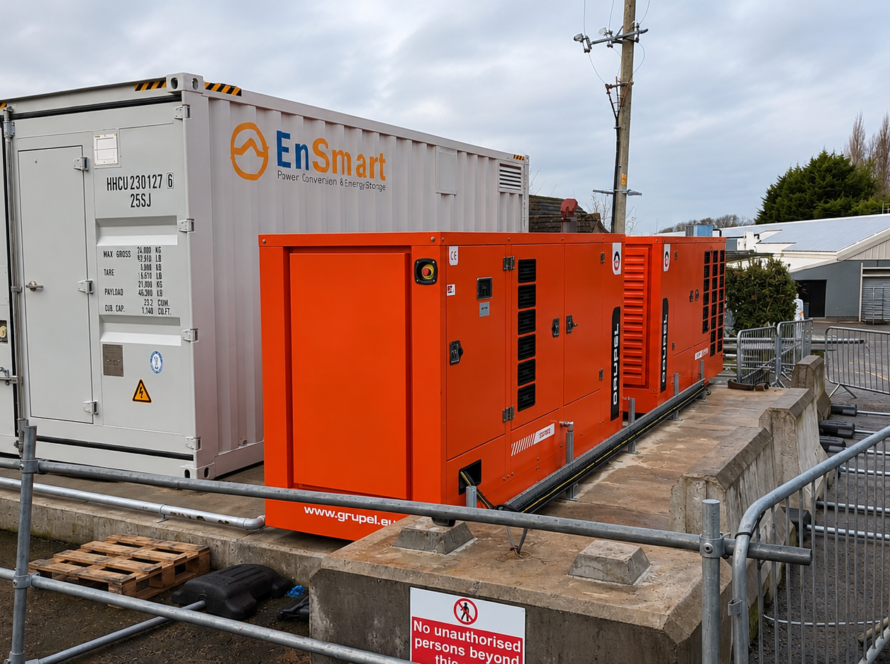
How farm solar battery storage is helping Essex farms cut agricultural energy costs and cope with the grid limits that come with rural sites.
Battery storage for Essex farms works the same way it does for any commercial site — storing solar generation or cheap off-peak electricity for use later — but the case for farms is often stronger than most other businesses. Agricultural sites frequently run energy-intensive equipment with sharp, unpredictable peaks: grain dryers at harvest, refrigeration on dairy and poultry units, irrigation pumps, and increasingly robotic milking systems, all on rural grid connections that were never designed for that kind of load and can be genuinely difficult or slow to upgrade. A battery lets a farm smooth those peaks, make far better use of its own solar generation, and in some cases avoid a costly rural grid reinforcement altogether — while farm solar battery storage projects can also draw on Defra’s Improving Farm Productivity grant, which covers up to 25% of eligible costs including battery storage itself.
Farms have some of the most demanding and least forgiving electricity profiles of any commercial site. A dairy unit’s refrigeration and milking equipment can’t simply pause because the grid is under strain. A grain store’s driers run flat out for a few intense weeks at harvest and then barely at all the rest of the year. Poultry sheds need constant ventilation and heating regardless of the time of day. None of that fits neatly with how the rural electricity network was originally built.
This guide looks at why agricultural energy costs across Essex are so exposed to these demand spikes, why rural grid connections make the problem worse, and how farm solar battery storage — often supported by Defra grant funding — is helping Essex farms take back some control over their energy bills.
Most commercial energy advice assumes a fairly steady weekday demand pattern. Farms don’t work that way — demand can swing from near-zero to a hard peak within minutes, driven by weather, harvest timing or animal welfare needs rather than an office schedule. That’s exactly the kind of profile battery storage is built to smooth.
Essex’s mix of arable, dairy, poultry and mixed farming means agricultural electricity demand across the county varies enormously by season and by farm type. Grain drying loads a huge amount of electricity into a short autumn window. Dairy and poultry operations carry near-constant refrigeration, ventilation and process loads through the whole year. Irrigation pumping spikes hard during dry summer spells. Each of these creates a demand profile that’s difficult to manage on a standard fixed tariff, and expensive if it regularly pushes a farm’s peak demand or contracted capacity higher than necessary.
Layered on top of that, many smaller agricultural sites remain on older, higher-cost electricity contracts, sometimes paying well over 20p/kWh for grid electricity — a rate that makes every kilowatt-hour a farm can generate and use itself worth considerably more than one it buys in.
Rural electricity networks were generally built decades ago to supply modest farmhouse and outbuilding loads, not the ventilation systems, robotic milking parlours, grain driers and irrigation pumps that modern agriculture now runs. Many rural sites still only have a single-phase supply, and even where three-phase power is available, the local network’s spare capacity can be limited.
A farm wanting to add a grain drier, an EV charging point for farm vehicles, or expand a poultry shed’s ventilation can find that its existing connection — or the wider local network — simply doesn’t have the spare capacity to support it without a DNO reinforcement. In genuinely rural parts of Essex, that reinforcement can take a long time and carry a significant cost.
Some equipment — larger grain driers, three-phase motors on certain pumps and processing equipment — simply requires a three-phase supply to run properly. Where a farm only has single-phase power, upgrading to three-phase is a separate project in its own right, and one worth investigating alongside any solar and battery plans rather than after the fact.
A solar and battery system installed on farm buildings addresses several of these problems at once, rather than solving just one.
Whether it’s worth adding a battery at all, or whether solar alone covers most of the benefit, depends heavily on the farm’s specific demand pattern. Our guide on battery storage vs solar panels only for business walks through that comparison in more detail.
Not every farm gets value from a battery in the same way — the priority shifts with the type of operation.
| Farm type | Main energy challenge | Where battery storage helps most |
|---|---|---|
| Arable / grain | Sharp seasonal peak from grain drying | Peak smoothing during harvest weeks |
| Dairy | Constant refrigeration and milking load | Self-consumption and backup power |
| Poultry | Continuous ventilation and heating | Self-consumption and resilience |
| Mixed / diversified | Variable load across multiple activities | Capacity headroom for new equipment |
Farm solar and battery projects can access dedicated agricultural grant funding that isn’t available to most other commercial sectors. The main route is Defra’s Improving Farm Productivity (IFP) grant, delivered through the Rural Payments Agency, which succeeded the earlier Farming Equipment and Technology Fund.
- Up to 25% of eligible capital costs, with grants ranging from £15,000 to £100,000 per business
- Covers solar PV panels, battery storage, inverters, meters and grid connection costs
- Includes up to 10% of project cost toward a grid upgrade where genuinely needed
- Solar must be installed on a farm-building rooftop or an irrigation reservoir — ground-mounted arrays are not eligible
- Assessed competitively on a points-based system covering energy efficiency, emissions reduction and farm productivity
IFP rounds open on a specific schedule each year and are assessed competitively rather than first-come, first-served — a strong, well-documented application matters as much as the underlying project. It’s worth planning your farm’s solar and battery project well ahead of a round opening, since design, quotes and paperwork all take time to prepare properly.
The right starting point for any Essex farm is a site assessment covering your buildings, your existing grid connection, and your actual seasonal demand pattern — arable, dairy and poultry sites all need a genuinely different design, not a one-size-fits-all system.
- Large barn or outbuilding roof suitable for solar
- Seasonal or continuous high-demand equipment — driers, refrigeration, ventilation, pumps
- Recorded peaks that regularly push demand higher than the site’s baseline needs
- Existing supply confirmed as single-phase or three-phase
- Local grid capacity checked for any planned expansion or new equipment
- Any DNO reinforcement cost or timeline understood as a comparison point
- Improving Farm Productivity grant eligibility and current round dates checked
- Solar sited on farm-building rooftop or irrigation reservoir to remain grant-eligible
- Application documentation and quotes prepared well ahead of a funding window opening
- Farms have uniquely spiky demand profiles — harvest driers, refrigeration, irrigation — that suit battery storage well.
- Rural grid connections are often more constrained than urban ones, making battery-based peak smoothing especially valuable.
- Farm solar battery storage can draw on Defra’s Improving Farm Productivity grant, covering up to 25% of costs.
- The grant covers solar, battery storage, inverters and grid connection — but only on farm-building rooftops or irrigation reservoirs.
- Battery sizing should reflect your specific farm type — arable, dairy and poultry all have different demand patterns.
Considering solar and battery storage for your farm?
We’ll assess your buildings, grid connection and seasonal demand, and help you understand how Defra grant funding fits your project.